Importing Apparel from India to the USA: Kidswear Guide
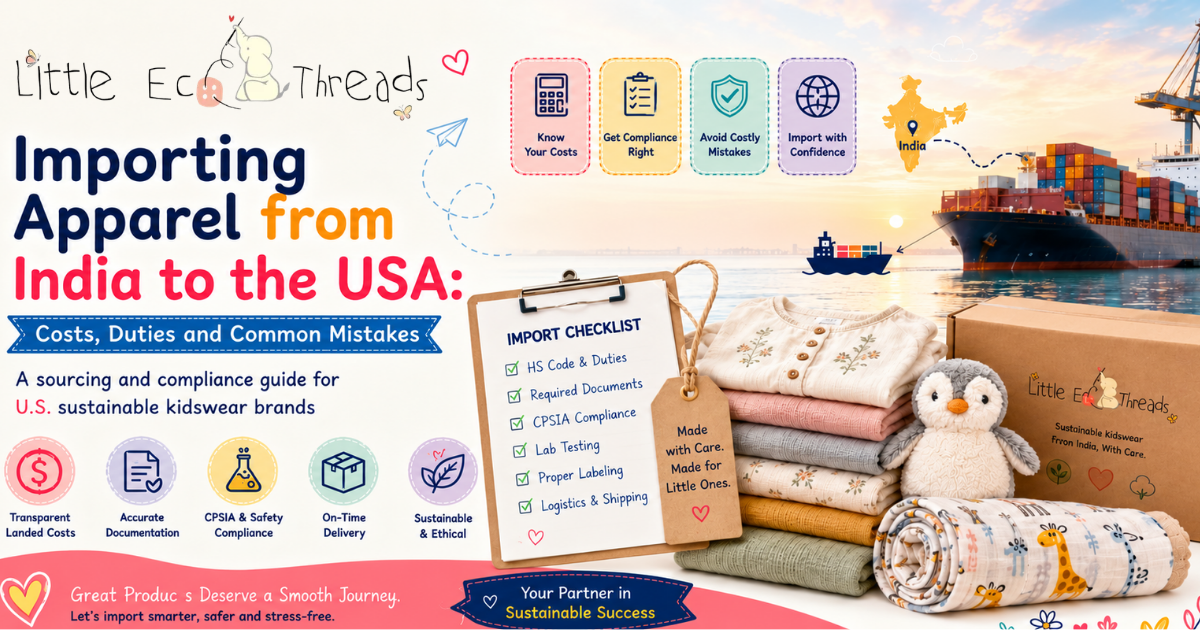
Importing apparel from India to the USA can be a strong sourcing strategy for children's clothing brands, especially when the goal is to combine quality production, sustainable materials, flexible order quantities, and export-ready documentation.
The opportunity is real, but so is the complexity. A beautiful kidswear collection can still be delayed at port if the commercial invoice does not match the packing list, the HTS code is wrong, labels are incomplete, or CPSIA documentation is missing. For U.S. brands, importing kidswear from India to USA markets requires both garment manufacturing knowledge and import compliance discipline.
This guide explains the costs, duties, documents, certifications, and common mistakes brands should understand before they import clothes from India, especially baby and kidswear made with organic cotton or other sustainable materials.
Why U.S. Brands Are Importing Apparel from India to the USA
Many U.S. brands are diversifying apparel sourcing and looking beyond a single manufacturing country. India has become a serious option for baby and kidswear because it combines textile knowledge, export experience, and access to responsible material supply chains.
For children's clothing brands, India is attractive for several reasons:
- Specialized textile skills: India's garment industry includes skilled tailors, embroiderers, print specialists, pattern makers, and quality-control teams.
- Organic cotton access: India is an important global source for organic cotton, which makes it relevant for brands seeking an Organic Cotton Kidswear production partner.
- Export experience: Many Indian factories already understand U.S., UK, EU, and Australian buyer expectations.
- Private label flexibility: A private label kidswear manufacturer India partner can often support labels, packaging, trims, sampling, and smaller launch runs.
- Sustainability ecosystem: Brands can source through a GOTS certified kidswear manufacturer, an organic cotton clothing manufacturer India partner, or an OEKO-TEX certified clothing manufacturer depending on the product and certification need.
This does not mean sourcing from India is automatic or risk-free. It means the manufacturing foundation is strong if the brand chooses the right partner and prepares the import process properly.
Import Duties and HTS Codes: What You Actually Pay
Every apparel shipment entering the United States needs the correct classification under the Harmonized Tariff Schedule (HTS). The HTS code helps determine the duty rate applied to the shipment.
For apparel, classification depends on details such as:
- Product type
- Knit or woven construction
- Fiber content
- Gender and age category
- Garment use
- Special construction details
A cotton knit T-shirt, woven cotton dress, synthetic pajama set, and quilted baby jacket can all fall under different HTS classifications. That matters because duty rates can vary meaningfully.
The most important rule is simple: do not guess. Work with a licensed customs broker and make sure your manufacturing partner provides accurate fabric composition, garment descriptions, and product details before documents are prepared.
Why HTS Mistakes Become Expensive
An incorrect HTS code can create delays, extra broker time, storage charges, duty adjustments, and additional scrutiny. For first-time importers, one common problem is reusing an old invoice template for a new product type.
For example, a brand might import cotton-blend hoodies but accidentally classify them using a code previously used for T-shirts. If customs identifies the mismatch, the shipment may be held until the classification is corrected. While the issue is being resolved, demurrage, storage, and broker charges can keep increasing.
The garment itself may be perfectly made. The problem is paperwork. That is why import planning should begin before production, not after packing.
Documentation Required to Import Clothes from India
Missing or mismatched paperwork is one of the most common causes of shipment delays. At minimum, importers should prepare and review the following documents:
| Document | Why It Matters |
|---|---|
| Commercial invoice | Shows itemized values, product descriptions, buyer, seller, currency, and shipment details |
| Packing list | Confirms carton count, weights, quantities, and contents |
| Bill of lading or airway bill | Issued by the carrier or freight forwarder |
| Certificate of origin | Confirms the country where garments were manufactured |
| Fiber content and care labels | Helps support FTC Labeling Requirements |
| Test reports | Supports CPSIA, GOTS, OEKO-TEX, or retailer-specific requirements |
| Children's Product Certificate | Required for many children's products sold in the U.S. |
| Tracking label details | Supports product traceability for children's goods |
| Importer of record details | Identifies the party legally responsible for the customs entry |
The importer of record remains responsible for the accuracy of the entry, even when a freight forwarder or customs broker helps prepare documents. Outsourcing paperwork support does not outsource legal responsibility.
CPSIA Compliance for Kidswear
Children's apparel entering the United States must be reviewed through a stricter lens than adult apparel. The Consumer Product Safety Commission oversees product safety rules for consumer products, including children's products.
For kidswear, CPSIA compliance for kidswear can involve:
- Limits on lead in children's products
- Restrictions on certain phthalates where applicable
- Testing by CPSC-accepted third-party laboratories where required
- A Children's Product Certificate for covered children's products
- Permanent tracking labels
- Additional requirements for specific categories, such as children's sleepwear flammability rules
Brands should confirm applicable requirements with qualified compliance advisors, test labs, or regulatory resources before importing. The exact rules can depend on product type, age range, trims, materials, and intended use.
Sustainability Compliance for Kidswear
Sustainable kidswear manufacturing is not only about choosing a softer fabric. Certifications and testing help brands prove that their claims are credible.
GOTS Certified Organic Cotton
GOTS Certified Organic Cotton is especially relevant for baby and kidswear brands because the GOTS Certification standard covers organic fiber status and includes environmental and social criteria across textile processing.
If your brand plans to market garments as organic, confirm early whether the fabric, processing, dyeing, and labeling can support that claim. Certification should be planned before production, not added at the end.
OEKO-TEX Testing
OEKO-TEX testing is widely recognized for harmful substance screening in textiles. It can support product safety positioning, particularly for garments worn close to children's skin.
For brands looking for an OEKO-TEX certified clothing manufacturer, ask whether certificates are current, which facility or product scope they cover, and whether the certificate can be verified.
Textile Exchange And Responsible Materials
Textile Exchange is a useful reference point for brands tracking preferred fibers, responsible sourcing, and material standards. If your collection uses organic cotton, recycled fibers, or other preferred materials, align the sourcing story with documentation that buyers and retailers can understand.
AZO-Free And Safer Dyeing Expectations
Many U.S. retailers expect children's garments to avoid restricted or high-risk dye chemistry, especially for skin-contact products. Even when a requirement is retailer-driven rather than customs-driven, it still matters commercially.
Why Children's Clothing Standards Are Stricter
Children have more sensitive skin than adults, and younger children may put fabric, trims, or sleeves in their mouths. That creates a higher safety expectation for fabrics, dyes, trims, labels, and finishing.
For baby and kidswear brands, compliance is not a backend technicality. It is part of the product promise. A reliable Kidswear Manufacturer should understand that a brand is buying safety, consistency, and documentation as much as stitching.
10 Common Mistakes First-Time Apparel Importers Make
1. Choosing a manufacturer on price alone
The lowest quote may exclude testing, labeling, compliant packaging, sampling revisions, or quality checks. Those costs usually appear later.
2. Delaying certifications until after production starts
If you need organic cotton, GOTS, OEKO-TEX, or other documentation, plan it before fabric sourcing and production.
3. Skipping the sampling stage
Moving directly to bulk production can turn a small fit or construction issue into a large inventory problem.
4. Sending vague tech packs
Incomplete specs force the factory to make assumptions about measurements, trims, stitching, labels, and finishing.
5. Communicating too little during production
Regular production updates help catch issues while they are still fixable.
6. Using the wrong HTS classification
HTS classification should be checked carefully with a customs broker, especially when product construction or fiber content changes.
7. Treating compliance as the factory's problem
The importer of record is responsible for compliance on the U.S. side. A good factory can support documents, but the brand still needs to understand its obligations.
8. Skipping third-party or pre-shipment inspection
Strong Quality Control costs less than rejected shipments, customer returns, or damaged retail relationships.
9. Underestimating packaging and label requirements
Incorrect care labels, missing tracking labels, or inconsistent carton details can slow down clearance.
10. Accepting unrealistic lead times
Reliable production timelines should include time for sampling, material sourcing, testing, manufacturing, inspection, packing, and shipping.
How Little Eco Threads Helps Reduce Import Risk
Little Eco Threads supports baby and kidswear brands that want to manufacture responsibly in India and ship with better preparation.
Our work is built around the same practical safeguards covered in this guide:
- Organic cotton and certified material sourcing where required
- Sampling stages before bulk production
- Private label trims, labels, and packaging support
- Documentation support during production
- In-house quality checks at multiple stages
- Export-ready communication and shipment preparation
- Flexible production for startups and growing brands
For brands looking for Lower MOQs, this matters. A small MOQ clothing manufacturer India partner can help a brand test a collection without overcommitting inventory, while still planning the documentation and quality systems needed for U.S. import.
Our goal is not to make importing sound effortless. It is to help brands understand the process early, avoid common mistakes, and build a smoother path from sample approval to delivery.
Checklist Before Placing Your First Order
Before importing kidswear from India to USA buyers, review this checklist:
- Confirm the manufacturer has relevant certifications and current documentation.
- Prepare a complete tech pack with measurements, fabric, trims, labels, and construction details.
- Approve proto, fit, and pre-production samples before bulk production.
- Confirm fiber content and care labeling requirements.
- Review CPSIA testing requirements for the specific product category.
- Confirm Children's Product Certificate responsibilities where applicable.
- Check HTS classification with a licensed customs broker.
- Agree freight method and Incoterms in writing.
- Schedule quality inspection before shipment.
- Build buffer time for testing, customs clearance, and possible document corrections.
The International Trade Administration and other official trade resources can help importers understand the broader U.S. trade environment, but product-specific classification and compliance should be checked with qualified professionals.
Frequently Asked Questions
How much duty will I pay to import kidswear from India?
Duty depends on HTS classification, product construction, and fiber content. There is no single flat kidswear duty rate. A customs broker should confirm the correct classification before shipment.
Can a startup import clothes from India?
Yes. Startups commonly import from India when they work with manufacturers that support smaller test launches, private label development, and realistic production planning.
What certifications should a sustainable kidswear manufacturer India partner provide?
Relevant documents may include GOTS, OEKO-TEX, fabric test reports, CPSIA-related test reports, and other certificates depending on the product and claim being made.
Is organic cotton kidswear more expensive to import?
Organic cotton fabric usually carries a material premium, but import duty is generally driven by classification and fiber composition rather than whether the cotton is marketed as organic.
Do I need a customs broker?
Many brands use a licensed customs broker because apparel classification, duty calculation, and import documentation can be complex. A broker can reduce the risk of avoidable mistakes.
Can Little Eco Threads help with U.S.-bound kidswear orders?
Yes. Little Eco Threads supports private label kidswear development, sampling, production, quality checks, and export documentation support for brands selling into the United States.
Import With More Confidence
Importing Apparel from India to the USA is not difficult because the garments are hard to make. The real challenge is managing the details that sit around production: HTS classification, CPSIA compliance, documentation, labeling, testing, quality control, freight planning, and realistic timelines.
The brands that import successfully do not treat sourcing as a simple purchase order. They build strong manufacturing relationships, ask compliance questions early, plan total landed cost, and work with partners who understand both product quality and export preparation.
If you are building a sustainable kidswear brand and need an organic cotton kidswear manufacturer, GOTS certified kidswear manufacturer, or private label kidswear manufacturer India partner, contact Little Eco Threads. We can help you plan the next step with clarity.