Low MOQ Kidswear Manufacturer for Smart Startups
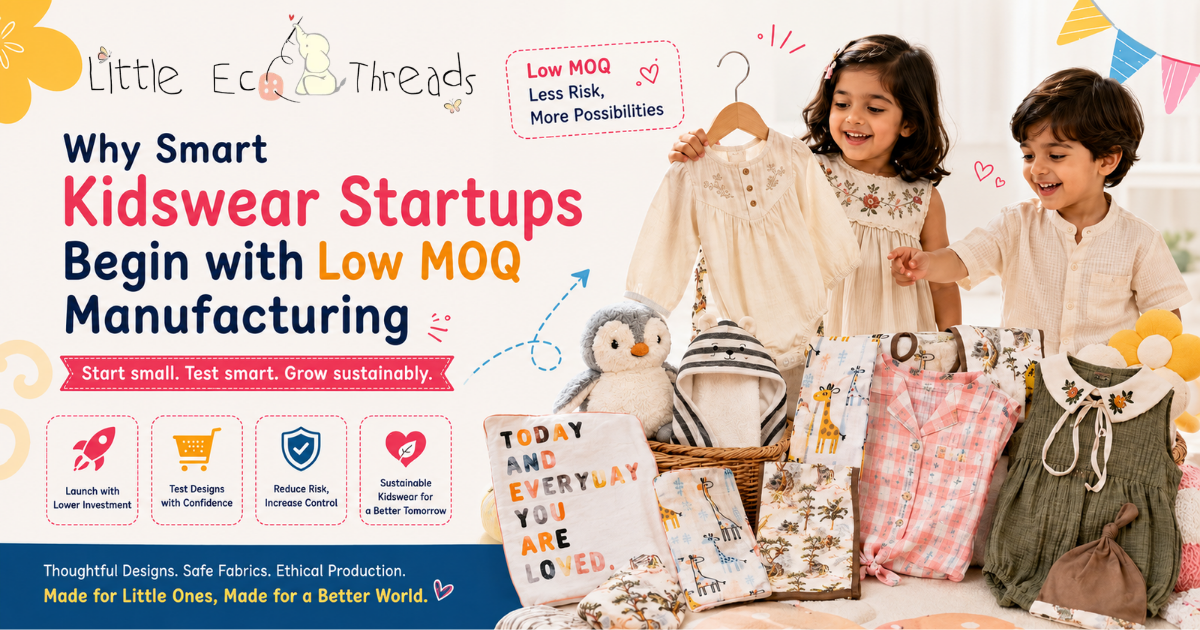
Choosing a low MOQ kidswear manufacturer can change the way a new children's clothing brand launches. Instead of committing cash to a large production run before the market has responded, founders can start with a controlled first order, test real demand, and scale the designs that prove themselves.
MOQ means minimum order quantity: the smallest number of garments a factory is willing to produce in one order. For startups, that number affects almost every early business decision, including budget, inventory risk, product testing, sampling, sizing, photography, and cash flow.
This guide explains why low MOQ manufacturing matters for kidswear startups, what to look for in a sustainable manufacturing partner, and how brands can use small batches to launch with more control.
Why Low MOQ Kidswear Manufacturer Support Matters
Every founder starts with a creative idea: a romper collection, a birthday dress range, a capsule of organic basics, or a small run of private label kidswear. The manufacturing decision is where that idea becomes a real business risk.
If the first order is too large, the brand may run out of working capital before it has tested demand. If the order is too small for the manufacturer to manage properly, the brand may face poor communication, inconsistent quality, or high sample costs.
A startup-friendly partner sits between those extremes. Little Eco Threads supports brands that want to begin thoughtfully, build product-market confidence, and avoid unnecessary inventory pressure in the first season.
For baby and kidswear, this matters even more because:
- Size ranges can be difficult to forecast.
- Parents are sensitive to fabric feel, fit, and wash performance.
- Seasonal demand can move quickly.
- Safety and labeling details need more care than adult apparel.
- New brands often need money left for photography, packaging, ads, and wholesale outreach.
Low MOQ manufacturing is not only about ordering fewer units. It is about buying time to learn.
What MOQ And Minimum Order Quantity Really Mean
MOQ, or minimum order quantity, is the smallest production volume a factory accepts for a specific style, color, fabric, or order.
Different manufacturers calculate MOQ differently. One factory may quote MOQ per design. Another may quote MOQ per color. A fabric mill may set a separate minimum for custom dyeing or printing. Labels, trims, buttons, packaging, and embroidery can each have their own minimums.
That is why founders should ask specific questions:
| MOQ Question | Why It Matters |
|---|---|
| Is the MOQ per style, color, size, or total order? | This determines the real launch quantity. |
| Does fabric have a separate minimum? | Fabric MOQ can be higher than garment MOQ. |
| Can sizes be mixed within the MOQ? | Kidswear brands need flexible size breaks. |
| Are labels and packaging included? | Private label details may have separate costs. |
| What happens on reorders? | The first order and reorder MOQ may differ. |
A low MOQ clothing manufacturer should explain these details clearly before sampling begins. If the answer is vague, the founder may discover the real minimum only after spending money on development.
Why Smart Kidswear Startups Prefer Low MOQ
Founders who succeed in kidswear usually do not begin by producing the most inventory. They begin by making smaller decisions that create useful data.
Lower Investment To Launch
A smaller first run helps founders preserve cash for brand work, photography, marketing, packaging, and customer acquisition. This is important because a product cannot sell well if the brand has no budget left to show it properly.
Easier Product Testing
Customers may love one fabric and ignore another. A print that looks strong in a mood board may not convert online. Low MOQ production lets founders test designs with real customers instead of relying only on instinct.
Better Inventory Control
Unsold inventory is cash sitting in boxes. In kidswear, sizing adds another layer of risk because a brand may sell through toddler sizes quickly while slower sizes remain stuck.
Faster Improvements Between Batches
Parents give direct feedback on softness, fit, buttons, seams, waistbands, and wash performance. Smaller production runs allow a brand to improve the next batch quickly.
Cleaner Scaling
Once a design has sales data, larger orders become easier to justify. The brand can scale winners instead of guessing which styles deserve more inventory.
Why Sustainability Matters In Kidswear Manufacturing
Parents pay close attention to what touches a child's skin. Fabric quality, dye safety, finishing, and stitching are not abstract sustainability claims; they affect how a garment feels and performs in daily use.
A sustainable kidswear manufacturer should help a brand think through material choices, testing, traceability, waste, and responsible production practices from the beginning.
For a new brand, sustainability is also commercial. Buyers and parents increasingly expect clear answers about where products are made, what fabrics are used, and whether certifications can support the brand's claims.
Organic Cotton, GOTS, And OEKO-TEX
Many founders search for an organic cotton kidswear manufacturer or an organic baby clothing manufacturer because cotton is familiar, breathable, and widely used in baby and children's apparel.
Organic cotton can support a softer, more natural product story, but brands should be careful with claims. If a garment is marketed as organic, the supply chain and labeling need to support that claim.
GOTS is one of the most recognized standards for organic textiles, and the current Global Standards site describes GOTS as a globally recognized standard for organic fiber and finished textile processing. OEKO-TEX standards are also widely used for textile testing and product safety communication.
For brands comparing certification paths, the existing Little Eco Threads guide to OEKO-TEX and GOTS is a useful next read.
The practical takeaway is simple: ask for current certificates, confirm the scope, and check whether the certificate applies to the fabric, facility, product, or process you are relying on.
Children's Clothing Has Higher Safety Expectations
For children's clothing, safety is reviewed more carefully than many adult apparel categories because children are more vulnerable to unsafe trims, loose parts, harsh substances, and flammability risks.
In the U.S., the Consumer Product Safety Commission is a key official resource for children's product requirements and safety standards. Exact obligations depend on the product type, age range, fabric, trim, and intended use, so brands should confirm requirements with qualified compliance advisors or test labs before importing or selling.
For a startup, this affects manufacturing choices:
- Avoid risky trims on baby and toddler garments.
- Confirm fabric and dye testing expectations early.
- Keep records for materials, production batches, and labels.
- Review sleepwear, drawstring, and tracking label requirements where relevant.
- Build time for testing before shipment.
Strong compliance planning is not a delay. It is a way to protect the brand before the first customer order ships.
What To Look For In A Low MOQ Clothing Manufacturer
Choosing the right factory is not only about whether the first quote fits the budget. A good partner should make the early stage easier to manage.
Look for these capabilities:
- Low MOQ options: The manufacturer should support smaller launch runs without treating the brand as an inconvenience.
- Kidswear experience: Baby and children's clothing need specific attention to fit, comfort, seam quality, trims, and safety.
- Organic and eco-friendly fabrics: An eco-friendly kidswear manufacturer should be able to explain available materials and documentation.
- Private label support: Labels, tags, packaging, and brand presentation matter even in the first production run.
- Sampling discipline: Samples should be used to confirm fit, fabric, measurements, and finishing before bulk production.
- Quality checks: Production should include in-line and final checks, not only a quick look at packed cartons.
- Clear communication: Founders need realistic timelines, written confirmations, and honest answers.
- Scalability: The partner should support both the first small order and larger repeat orders later.
If a supplier offers a low price but cannot explain process, quality control, or documentation, the risk usually appears later.
Low MOQ Sustainable Kidswear Manufacturer Checklist
A low MOQ sustainable kidswear manufacturer should help the founder plan both launch and growth.
Before placing an order, ask:
- What is your MOQ per style, color, and total order?
- Can I mix sizes within the minimum order quantity?
- Which organic cotton fabrics are available now?
- Can you support GOTS or OEKO-TEX documentation where required?
- Do you provide proto, fit, and pre-production samples?
- What is your normal production lead time after sample approval?
- What quality control steps happen before shipping?
- Can you support custom labels, packaging, embroidery, or prints?
- What happens if a style sells quickly and I need a reorder?
- Can you scale with the brand after the first season?
These questions reveal whether the manufacturer is truly built for startup production or simply willing to accept one small order.
Common Mistakes New Kidswear Brands Make
Most early manufacturing problems are avoidable with clearer planning.
Ordering Too Much Inventory
Excitement about a launch can make a large order feel rational. In practice, smaller first runs give founders more control and less pressure.
Choosing Only On Price
The cheapest supplier may cut corners on fabric quality, stitching, communication, documentation, or inspection. Low MOQ should not mean low standards.
Skipping Samples
Sampling is where fit, measurements, trim placement, fabric feel, and wash performance are tested. Skipping it can turn a small issue into a full production problem.
Ignoring Certifications
Certifications and test reports are not decorative paperwork. For organic babywear and sustainable children's clothing, they help protect product claims and buyer confidence.
Underestimating Communication
Unclear specs lead to avoidable mistakes. Confirm measurements, labels, fabric, color, trims, packaging, and timelines in writing.
Not Planning Reorders
If a design sells well, the brand should know how quickly it can reorder and whether the same fabric will still be available.
Quality Control Is Where Low MOQ Still Has To Perform
Small-batch production still needs structure. A low MOQ run should not be treated as casual or experimental once the order is approved.
Good quality control checks should cover:
- Fabric inspection before cutting
- Measurement checks during production
- Stitching and seam review
- Trim and label placement
- Color and print consistency
- Final packing and carton checks
Quality consistency is one reason founders should choose startup friendly kidswear manufacturers rather than general factories that are not built around smaller production runs.
Why India Works For Low MOQ Kidswear
India has a deep textile ecosystem, from cotton and spinning to printing, embroidery, stitching, and export documentation. That makes it a strong sourcing base for founders who want material choice, customization, and production flexibility.
For sustainable kidswear, India is especially relevant because it has access to organic cotton supply chains and skilled garment production teams. A custom kidswear manufacturer in India can often support custom prints, embroidery, trims, labels, packaging, and small launch collections in one production relationship.
Ethical sourcing still needs verification. Brands should ask how the manufacturer approaches ethical production, safe working conditions, and fair wages. The International Labour Organization is a useful official reference point for decent work and labor standards across supply chains.
How Little Eco Threads Supports Startup Kidswear Brands
Little Eco Threads works with baby and kidswear founders who want to start responsibly without overordering.
Our production approach supports:
- Low MOQ launch quantities
- Organic cotton and eco-friendly fabric options
- Sampling before bulk production
- Private label trims, labels, and packaging
- Custom prints, embroidery, smocking, and seasonal styles
- Quality checks through production
- Export-focused communication and documentation support
- Room to scale after the first successful order
If you are building private label kidswear, the goal is not just to produce garments. It is to create a product foundation that helps the brand look credible from the first collection.
Frequently Asked Questions
What is a low MOQ kidswear manufacturer?
A low MOQ kidswear manufacturer is a production partner that accepts smaller order quantities for baby and children's clothing, making it easier for startups to test products before scaling.
What does MOQ mean?
MOQ means minimum order quantity. It is the smallest number of units a manufacturer will produce for a style, color, size range, or total order.
What is a good MOQ for a startup kidswear brand?
There is no single perfect number. Many startups begin with a controlled capsule collection and increase quantities after they see what customers actually buy.
Can low MOQ production still be sustainable?
Yes, if the manufacturer uses responsible fabrics, clear sourcing, thoughtful cutting, good production planning, and credible certification support where needed.
Should I choose GOTS or OEKO-TEX?
It depends on your product and claim. GOTS is relevant for organic textile certification, while OEKO-TEX is commonly used for harmful substance testing and textile safety communication.
Can I build a private label kidswear brand with low MOQ?
Yes. Many founders start private label kidswear with a small first run, custom labels, and a focused product range before expanding.
Why is quality control important for small orders?
Small orders still represent a brand's reputation. Poor stitching, uneven sizing, or fabric issues can damage trust quickly, especially in children's clothing.
Start Small, Test Smart, Then Scale
A low MOQ kidswear manufacturer gives a founder the freedom to launch without betting the whole budget on one production decision.
The strongest startup brands use that flexibility carefully. They test designs, listen to customers, improve between batches, protect quality, and build a manufacturing relationship that can scale with demand.
If you are looking for a low MOQ clothing manufacturer, organic cotton kidswear manufacturer, organic baby clothing manufacturer, or sustainable children's clothing manufacturer for your first or next collection, contact Little Eco Threads. We can help you plan a practical launch path with lower risk and better production clarity.