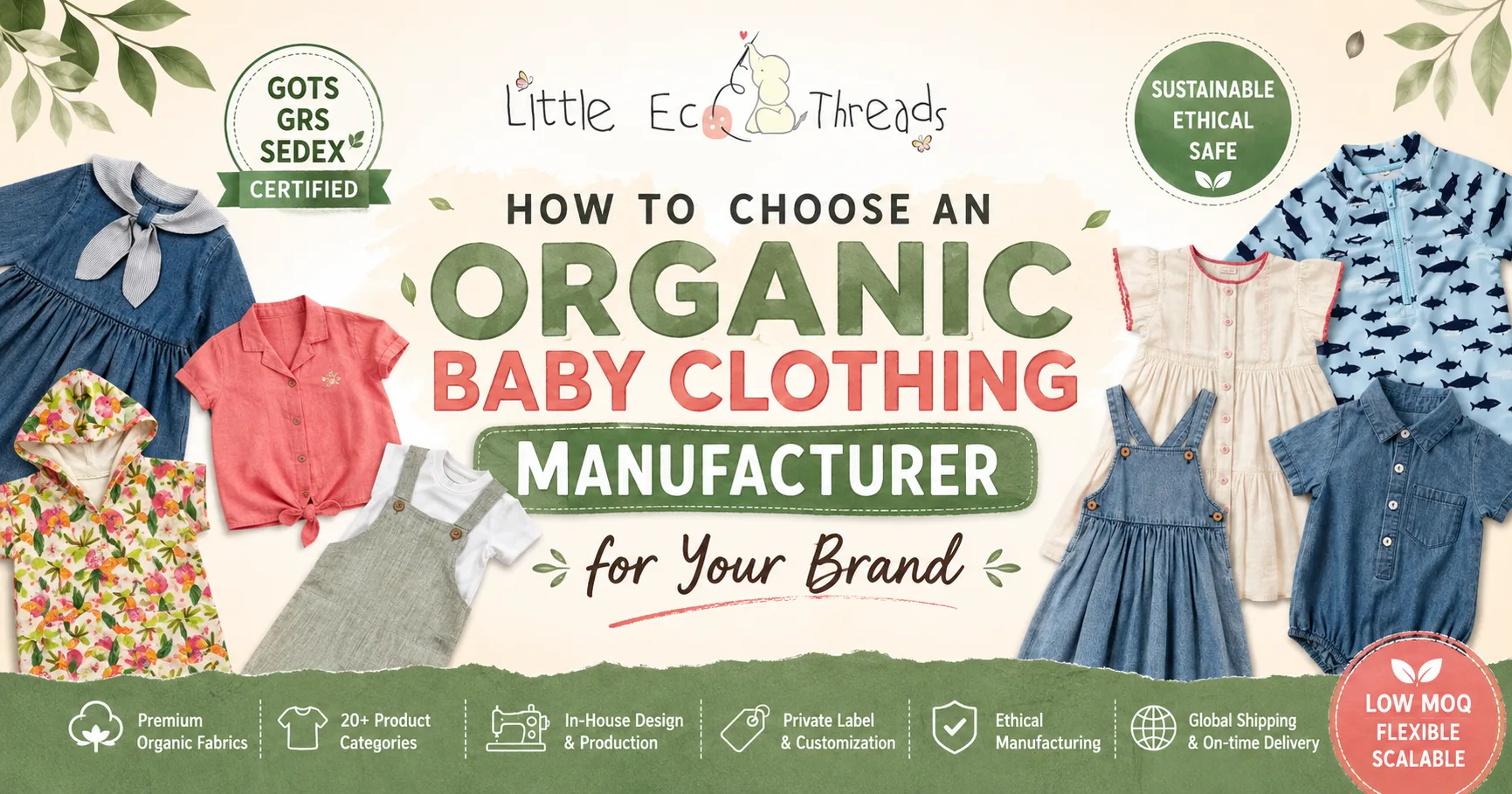
How to Choose an Organic Baby Clothing Manufacturer
Choosing an organic baby clothing manufacturer is not just about finding a factory that can sew babywear. The word "organic" is easy to put on a hangtag, but harder to prove across fabric sourcing, processing, trims, dyeing, labeling, and production documentation.
For baby clothing, that proof matters. Babies have sensitive skin, garments are washed repeatedly, and parents increasingly want to understand what goes into the products they buy. A manufacturer should be able to explain what it can certify, what it can produce consistently, and what documentation supports the claims your brand wants to make.
This guide explains how to evaluate an organic baby clothing manufacturer before placing an order, using Little Eco Threads as a practical example of the questions worth asking.
1. Check Organic Baby Clothing Manufacturer Certifications
Certifications exist because "organic" can become vague if it is not backed by documentation. Before comparing prices or product photos, ask which certifications an organic baby clothing manufacturer holds, what each one covers, and whether current documents are available.
GOTS is one of the most recognized standards for organic textiles. It covers organic textile processing and includes environmental and social criteria within its certification scope. A GOTS certificate is not automatically universal across every product a manufacturer makes, so ask whether it applies to the fabric, processing unit, garment facility, or specific product category.
GRS answers a different question: whether recycled-content claims can be supported. It is relevant for recycled fibers and blends, but it does not replace GOTS for an organic cotton claim.
OEKO-TEX Standard 100 is different again. It focuses on testing textile products and components for harmful substances. It does not prove organic farming, but it can support chemical-safety reassurance for printed, dyed, or trimmed baby garments.
Sedex membership and SMETA audits focus on supplier practices, including labor, health and safety, environmental performance, and business ethics. They are not product certifications and should not be treated as proof that a garment is organic.
For example, Little Eco Threads works with GOTS, GRS, and Sedex-aligned production standards and can discuss certification and audit documentation with brand buyers. That kind of clarity is what you should expect from any manufacturer you shortlist.
2. Evaluate Fabrics And Materials
Certifications tell you what can be verified. They do not tell you whether a fabric is right for the product you are developing, especially if your brand plans to sell organic cotton clothing across several baby and toddler categories.
Organic cotton jersey and organic cotton corduroy may both support an organic cotton story, but they perform differently against newborn skin and in a washing machine. Fabric hand feel, GSM, stretch, shrinkage, colorfastness, and finishing matter as much as fiber name.
For babywear, common fabric questions include:
- Is the organic cotton GOTS certified?
- What GSM range is available?
- Does the fabric shrink after washing?
- Is the fabric suitable for newborn skin?
- Can the mill or fabric source be documented?
- Are trims, thread, prints, and labels included in the testing or certification scope?
If you are wondering what is muslin, the simple answer is that muslin is a loosely woven cotton fabric material often used for swaddles, burp cloths, bibs, and lightweight blankets because it is breathable and softens with washing. If your range includes muslin swaddles, ask about GSM, weave density, shrinkage, and print durability.
Little Eco Threads works across organic cotton, muslin, cotton jersey, linen, denim, corduroy, and other babywear fabrics. For a brand building from newborn basics into toddler clothing, sourcing several fabric types from one partner can simplify development and quality control.
3. Review The Product Range
A manufacturer's product range shows whether it understands babywear as a category, not just apparel manufacturing in general. This is especially important when comparing kidswear manufacturer options, kids clothing manufacturers, and broader clothing manufacturers suppliers that may not specialize in baby products.
Useful product categories to ask about include baby basics, newborn clothing, summer wear, sleepwear, knitwear, swimwear, swaddles, gift sets, quilts, and older kidswear.
Range matters because a brand may start with one category and expand later. If your first collection is organic baby basics but your second collection adds swimwear, knitwear, or muslin accessories, it helps if the same manufacturer can support the next stage without restarting the sourcing process.
The Little Eco Threads catalog covers more than core baby basics. It includes summer styles, swimwear, knits, sleepwear, swaddles, gift sets, denim, linen, embroidery, smocking, and accessories. That breadth is useful when premium kidswear brands want one production relationship across multiple baby and kidswear categories.
Summer wear is also worth planning early, even when the first range is focused on basics. Lightweight fabrics, breathable shapes, sun-friendly coverage, and easy care all affect how a summer collection performs. For broader brand planning, the guide to Summer wear can help frame private-label category decisions.
4. Assess Customization And Private Label Support
Before committing to a manufacturer, confirm what happens in-house and what is outsourced. Outsourced steps can add cost, timing risk, and quality-control gaps. The same applies whether you call the service private labeling, white label clothing, OEM, or ODM.
Ask direct questions:
- Do you support OEM, ODM, or both?
- Can you develop patterns from a sketch?
- Do you need a complete tech pack before sampling?
- How many sample revisions are included?
- Is printing, embroidery, washing, or dyeing handled in-house?
- Do you support private labeling?
- Can you develop custom labels, hang tags, branded bags, and packaging?
- Can you follow our brand size chart and grading?
A strong organic babywear manufacturer should be able to support design development, sampling, cutting, stitching, finishing, quality checks, labeling, and packing through a clear process.
Little Eco Threads describes its workflow around design and development, sampling, production, and delivery, with support for pattern making, printing, embroidery, smocking, appliqué, Pantone color matching, labels, and packaging. The important point is not only that these services exist, but that the manufacturer can explain how each step is controlled.
5. Ask About Quality Control And Baby Safety
Quality control matters in every apparel category, but babywear has less room for error. Babies cannot explain scratchy seams, loose trims, or irritation. Parents notice quickly when snaps feel weak, stitching pulls open, or a garment loses shape after washing.
Ask how the manufacturer checks:
- Stitching and seam strength
- Neckline, crotch, and leg opening construction
- Shrinkage after washing
- Colorfastness
- Fabric consistency between sample and bulk
- Security of buttons, snaps, and trims
- Loose threads, raw edges, and finishing defects
- Labeling and compliance documents for your target market
A defined inspection approach is stronger than a general claim that quality is important. If a manufacturer uses an AQL benchmark or another documented inspection system, ask how it is applied and at which stage.
6. Compare MOQ, Pricing, And Scalability
Minimum order quantity is often the first practical filter for a new brand, but it should not be judged as one number in isolation.
Ask whether MOQ applies per style, per color, per size range, or per total order. Also ask whether MOQ changes when you add custom fabric, private-label neck tape, custom trims, embroidery, or packaging.
A very low MOQ can be useful for testing, but it may come with a higher unit cost. A higher MOQ may reduce unit cost but increase stock risk. The right manufacturer should help you understand both sides.
The best partner can support a smaller first order and scale later. That saves the brand from re-qualifying a new supplier, rechecking certifications, and rebuilding fit and quality standards every time order volume grows.
7. Investigate Ethical And Responsible Manufacturing
Organic material is only one part of responsible babywear production. Brands also need to understand working conditions, environmental practices, factory systems, and labor standards.
Sedex and SMETA are useful because they give buyers a structured way to review supplier practices. But they should be described accurately. A SMETA audit does not certify a product as organic. It is a social audit methodology used to assess supplier sites.
When a manufacturer mentions Sedex or SMETA, ask:
- Is the factory an active Sedex member?
- Is there a recent SMETA audit?
- Which audit pillars were covered?
- Were corrective actions raised?
- Have those corrective actions been resolved?
- Can the report or summary be shared with buyers?
This is where ethical manufacturing becomes practical rather than abstract. You are not only asking whether the manufacturer sounds responsible. You are asking what it can document.
8. Request Samples Before Bulk Production
No amount of catalog browsing replaces physical samples. Before placing a large order, request samples in the fabric and construction you actually intend to produce.
Check:
- Fabric softness and hand feel
- GSM and drape
- Stitching at stress points
- Fit and measurements
- Color accuracy against your reference
- Shrinkage after washing
- Trim security
- Label placement
- Care instructions
- Packaging if the garment is private labeled
A sample is the cheapest stage to catch a problem. Fixing fit, fabric, or construction after hundreds of units are already cut and sewn is far more expensive.
Before a full collection, founders can also order free fabric swatches to compare fabric texture, weight, color, and hand feel before deciding what to sample.
9. Evaluate Communication And Reliability
Manufacturing is a long-term relationship. Communication quality often predicts how smoothly production will run.
Pay attention to:
- How quickly the manufacturer responds
- Whether answers are specific or generic
- Whether documentation is shared clearly
- Whether timelines are realistic
- Whether potential risks are explained early
- Whether the team asks useful questions about your market and customer
A manufacturer that is transparent before payment is more likely to communicate well after the order starts. Delays and issues can happen in manufacturing; what matters is whether the partner explains them early enough to solve them.
10. Questions To Ask Before Choosing A Manufacturer
Bring the same checklist to each factory conversation so answers can be compared fairly.
- What organic and sustainability certifications do you hold?
- Which products, fabrics, or facilities do those certificates cover?
- Can you provide certification and audit documentation?
- Where do your fabrics come from?
- Do you produce babywear regularly?
- What categories do you manufacture in-house?
- What is your MOQ by product type?
- How many sampling rounds are included?
- What private-label or white label clothing options do you offer?
- What quality-control standard do you follow?
- What documentation can you provide for my market?
- What are your normal production lead times?
- Can you scale as order volume grows?
- What happens if bulk production does not match the approved sample?
You can also compare answers against the site's Frequently Asked Questions, which cover common manufacturing, fabric, certification, sampling, MOQ, and private-label questions.
Why Little Eco Threads May Be Worth Considering
Little Eco Threads is an India-based baby and kidswear manufacturer producing for brands in Europe, the US, and Australia. It operates as the baby and kidswear division of Home Fashions and focuses on organic, sustainable, private-label, and custom babywear production. For brands comparing clothing manufacturers UK, garment production UK, and overseas manufacturing partners, the useful comparison is not only location; it is documentation, fabric quality, sampling discipline, communication, and whether the supplier can support the categories your brand needs.
Based on its published product range and certification language, it is strongest for brands that need:
- Organic cotton and muslin babywear
- GOTS, GRS, and Sedex-aligned documentation
- Knits, summer wear, swimwear, sleepwear, swaddles, linen, denim, and gift categories
- In-house design development and sampling support
- Private labeling and packaging
- Flexible order planning by product style
- International production and shipping experience
This does not mean it is automatically the right fit for every brand. Order volume, target price, market, product complexity, and launch timeline still matter. But for a brand evaluating organic and sustainability-focused babywear manufacturers, it gives you a concrete benchmark for the questions above.
FAQ
What should I ask an organic baby clothing manufacturer first?
Start with documentation. Ask what certifications the manufacturer holds, what each certificate covers, whether the documents are current, and whether they apply to your exact product or order.
Is organic cotton enough for baby clothing?
Organic cotton can be a strong material choice, but it is not enough on its own. The finished garment also depends on dyeing, printing, trims, stitching, fit, wash performance, labeling, and quality control.
What is the difference between GOTS and OEKO-TEX Standard 100?
GOTS is focused on organic textile standards and certified processing. OEKO-TEX Standard 100 tests textile products and components for harmful substances. They support different claims.
Why does Sedex matter for babywear brands?
Sedex membership and SMETA audits help buyers assess labor, health and safety, environmental practices, and business ethics at supplier sites. They are useful for ethical sourcing, but they do not certify a product as organic.
Should I request swatches or finished samples first?
Start with swatches when choosing fabrics, then request finished samples before bulk production. Swatches help compare fabric feel and weight, while finished samples confirm fit, construction, trim placement, and wash performance.
Final Takeaway
Choosing an organic baby clothing manufacturer is not about accepting the word "organic" at face value. It is about checking certifications, fabrics, product range, sampling, quality control, MOQ, ethical manufacturing, communication, and scalability.
The best manufacturer is not always the cheapest or the one with the largest catalog. It is the one that can prove its claims, produce consistently, answer clearly, and grow with your brand.
If you are building an organic babywear or kidswear collection, start with documentation, review the fabrics, request swatches, sample the exact product, and compare each organic baby clothing manufacturer against the same checklist before placing a larger order.