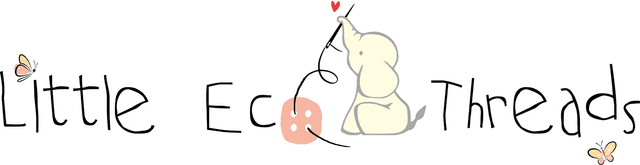
Building Sustainable Kidswear Collections with Organic Cotton Knitwear, Custom Designs and Low MOQ Manufacturing
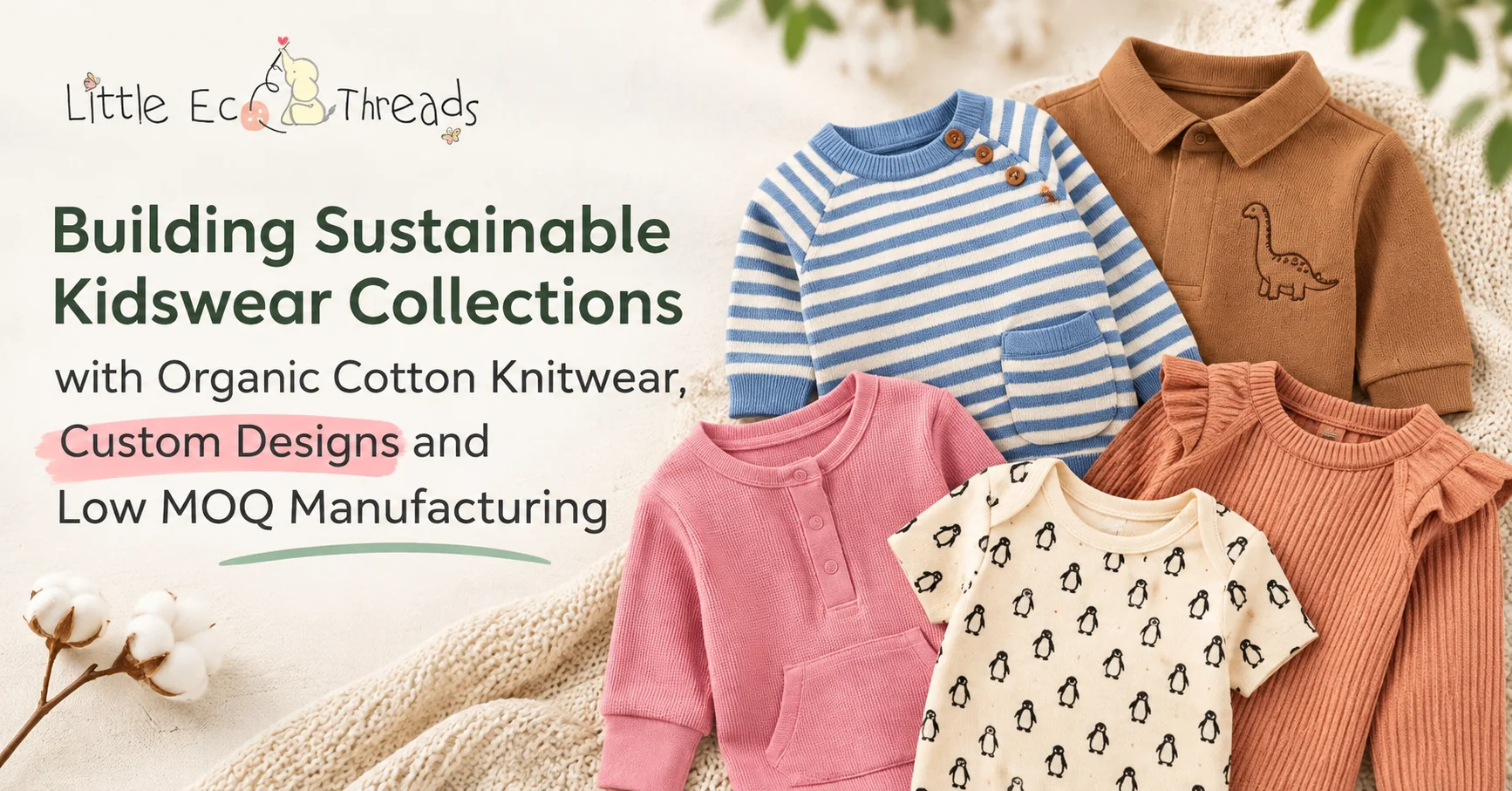
Why Sustainable Kidswear Collections Are Getting More Attention
Kidswear buyers have been asking harder questions about fabric for a few seasons now. Where did the cotton come from? Which certificate sits behind the claim on the hangtag? Can a smaller label get a proper knit collection made without committing to thousands of pieces per style? Brands that can answer these questions clearly tend to be the ones whose sourcing holds up when retailers and customers start asking too.
That is why choosing an organic cotton kidswear manufacturer has become a strategic decision rather than a purchasing detail. Knitwear is where it shows most. Ribbed rompers, wrap cardigans, sweatshirts and jersey sets sit against the skin for hours, survive repeated washing and carry a lot of a brand's identity in their handle, colour and finish. Material choice, design flexibility and order size all decide whether a collection works commercially.
This article looks at those three levers: organic cotton knitwear, custom design and low MOQ production. It also covers how to evaluate a manufacturing partner, and where Little Eco Threads, a sustainable kidswear and babywear manufacturer based in Noida, India, fits in. The company produces for baby and children's brands in Europe, the US and Australia, and its Knits collection is a useful reference for what flexible, small-batch knitwear production looks like in practice.
Understanding Organic Cotton Knitwear for Kids
Organic cotton is grown from non-GM seed under certified organic farming rules, which restrict synthetic pesticides and fertilisers. Knitwear is a separate question: it describes how the fabric is made. Instead of weaving yarns at right angles, knitting loops them together, which is why knits stretch, recover and feel softer in the hand. For babies and toddlers, that stretch matters as much as softness, because a garment has to get over a wriggling head and still sit comfortably.
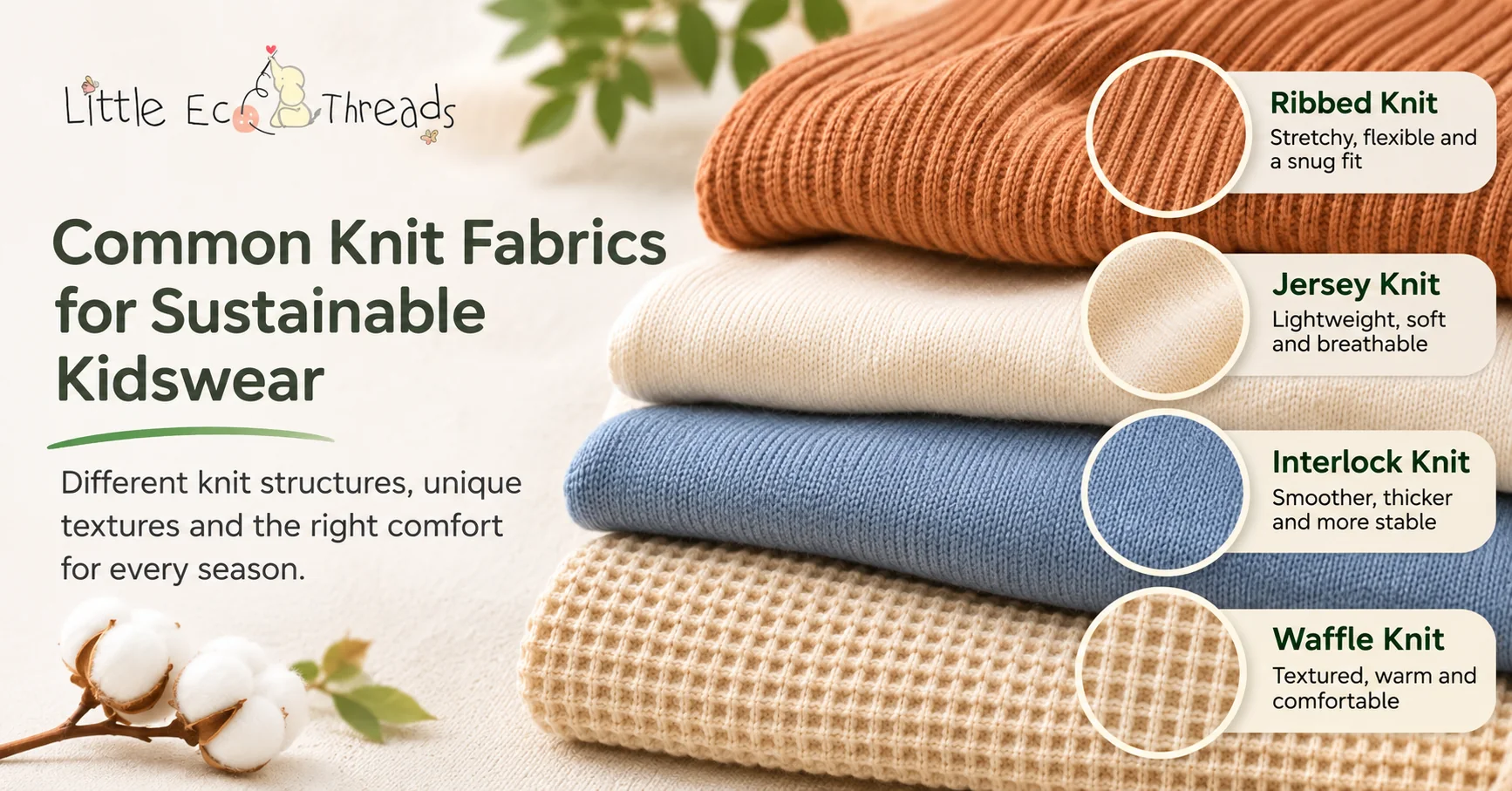
The knit structure changes the product. Fine jersey suits bodysuits and tees. Ribbed knits give rompers and leggings their snug, easy fit. Interlock is smoother and more stable, waffle adds texture and warmth, and looped-back fabrics make sweatshirts cosy without feeling heavy. Each behaves differently in sewing, shrinkage and finishing, so it is worth discussing the structure before the style.
Conventional cotton vs certified organic cotton
The difference is not visible in a swatch, which is exactly why certification matters. "Organic" on a label means little without a recognised standard behind it. GOTS, for example, requires at least 95% certified organic fibre for its top "organic" label grade, and 70% for "made with organic". It also audits processing, not just farming.
Buyers should also keep claims measured. Organic cotton is not automatically hypoallergenic, and softness depends as much on yarn quality, fabric weight (GSM), dyes and finishing as on the fibre's origin. When briefing a factory, these are the details worth specifying:
- Yarn type and count, and whether the cotton is combed or carded
- Fabric weight in GSM for the intended season
- Shrinkage tolerance after washing
- Dye and print method, and any certification the colour process must meet
Why Sustainable Kids Clothing Is Changing How Brands Choose Suppliers
Five years ago, a sustainability claim from a supplier was often a line on a company profile. Now it is a document request. Retailers, marketplaces and wholesale customers increasingly ask for certificates, material composition and factory audit information before they list a product. For children's apparel, scrutiny is higher still, because the end user is a baby or young child and the buyer is a parent reading labels closely.
In practice, sourcing teams tend to evaluate suppliers on a few things:
- Material transparency: what the fibre is, where it is sourced and whether it is certified
- Production practice: dyeing and finishing methods, chemical management and wastewater handling
- Social compliance: audited working conditions, usually through schemes such as SEDEX
- Recycled content: whether trims, packaging or fabrics use verified recycled inputs, for example under GRS
- Product safety: compliance with the rules of the destination market, such as CPSIA in the US or REACH in the EU
The useful shift here is that sustainability is becoming part of ordinary supplier due diligence, not a premium add-on. A manufacturer that can explain its materials and show its paperwork saves a brand weeks of back-and-forth, and makes it easier to substantiate claims on its own website and packaging.
That is also where a smaller brand can be at risk. Marketing language such as "eco" or "natural" without evidence invites trouble with retailers and, increasingly, advertising regulators. Working with a manufacturer that treats certification and documentation as routine (Little Eco Threads' own approach is outlined on its sustainability page) gives a collection something firm to stand on.
Custom Kids Knitwear: Designing a Collection That Looks Like Your Brand
Plenty of kidswear labels start by buying ready-made styles and adding a logo. It gets a product to market, but it rarely builds a recognisable range. Custom development lets a brand control the things customers actually remember: the colour story, the hand-feel of the fabric, the proportions, the small details.
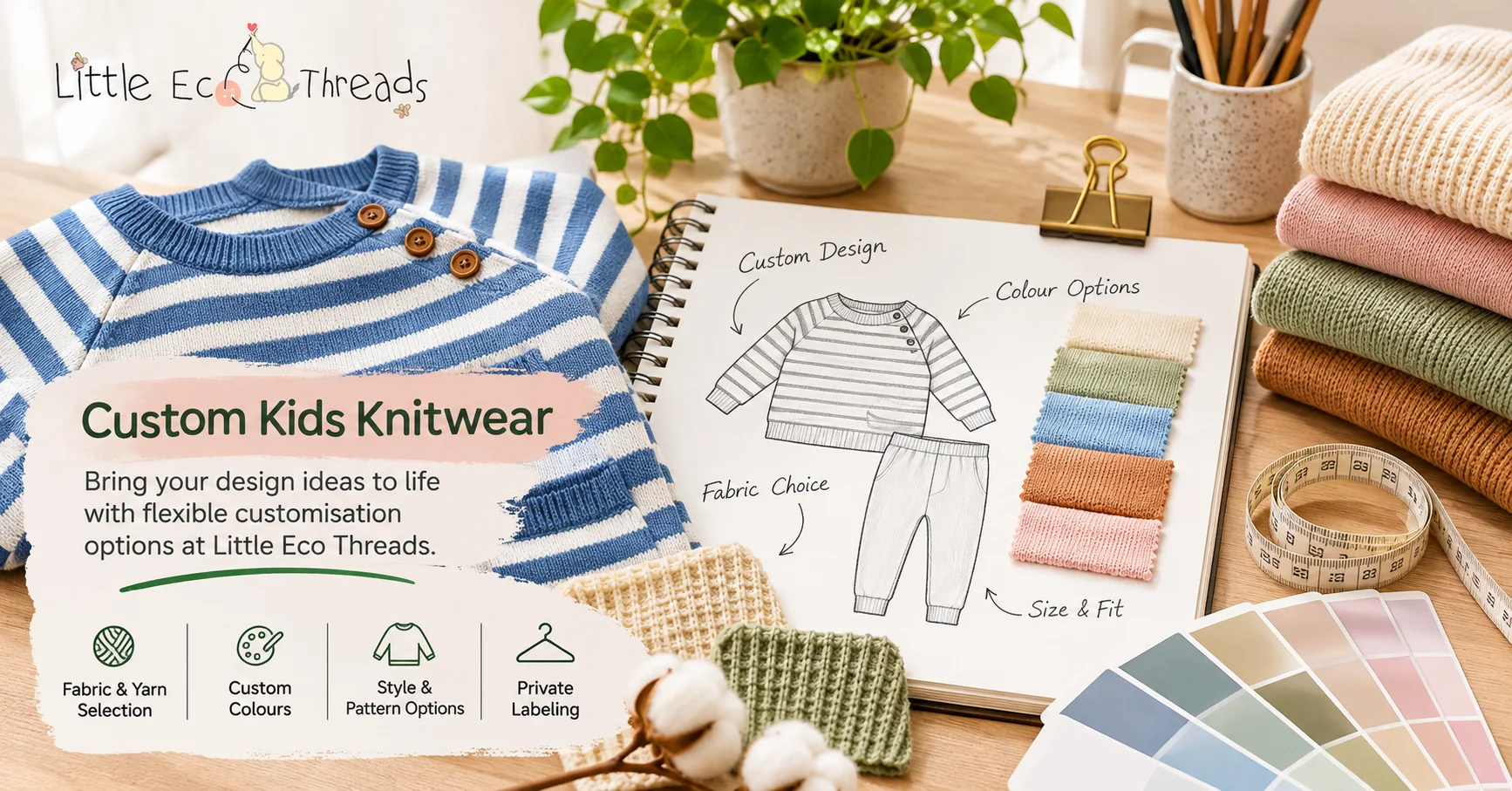
In knitwear, the customisable elements are broader than most new brands expect:
- Fabric and construction: ribbed jersey, interlock, waffle, looped-back or marl knits, each with a different weight and drape
- Colour: exclusive colourways, from earthy terracottas to soft pastels, developed against Pantone references or physical swatches
- Pattern and surface: yarn-dyed stripes, all-over prints, embroidery, appliqué and small hand-drawn motifs
- Garment details: neckline and closure type, popper placement, cuff and hem finish, pocket shape, drawstring or elastic waistbands
- Sizing and grading: a size range that matches the brand's market, from newborn through to older children
One practical tip: decide early which details are signature and which are standard. A distinctive stripe or colour palette, applied across ribbed rompers, wrap sets and joggers, gives a collection coherence without requiring a new pattern for every garment. It also keeps development costs and MOQs manageable.
Little Eco Threads develops custom knit colours and patterns for brand clients, and its custom manufacturing page is the place to start. Its Knits range covers ribbed rompers and bodysuits, wrap cardigan sets, sweatshirts and hooded styles, hooded towels and everyday separates, in sizes from 0-3M to 13, which gives brands a realistic base to adapt rather than starting from a blank page. Free fabric swatches are also available through its swatch request page, which is the fastest way to judge handle and colour before committing to a sample.
Low MOQ Kids Clothing Manufacturing: Keeping Collection Development Flexible
MOQ stands for minimum order quantity: the smallest run a factory will accept for a given style. Traditional garment factories often set it per style, per colour and sometimes per size, because fabric dyeing, knitting set-up and cutting all carry fixed costs. A low MOQ simply means the factory has structured its production so that smaller runs are still workable.
For kidswear, that flexibility matters for a few reasons. Children's sizes change quickly, trends in colour and print move by the season, and stock that sits unsold ages fast. A smaller first order lets a brand:
- Test a new silhouette or colourway before scaling it
- Launch a capsule collection without tying up cash in inventory
- Run a seasonal drop alongside its core range
- Reorder winners in better-informed quantities
Established brands use low MOQs for the same reasons, particularly for limited editions, exclusive retailer ranges and new-category tests.
What low MOQ does and does not mean
There is a trade-off worth being candid about. Very small runs can carry a higher unit cost, and not every fabric, dye lot or embellishment can be produced economically in tiny quantities. A custom-dyed knit, for instance, will usually need a higher minimum than a style made in a stock colour. Brands should treat MOQ as something to confirm style by style, not a single number that applies to everything.
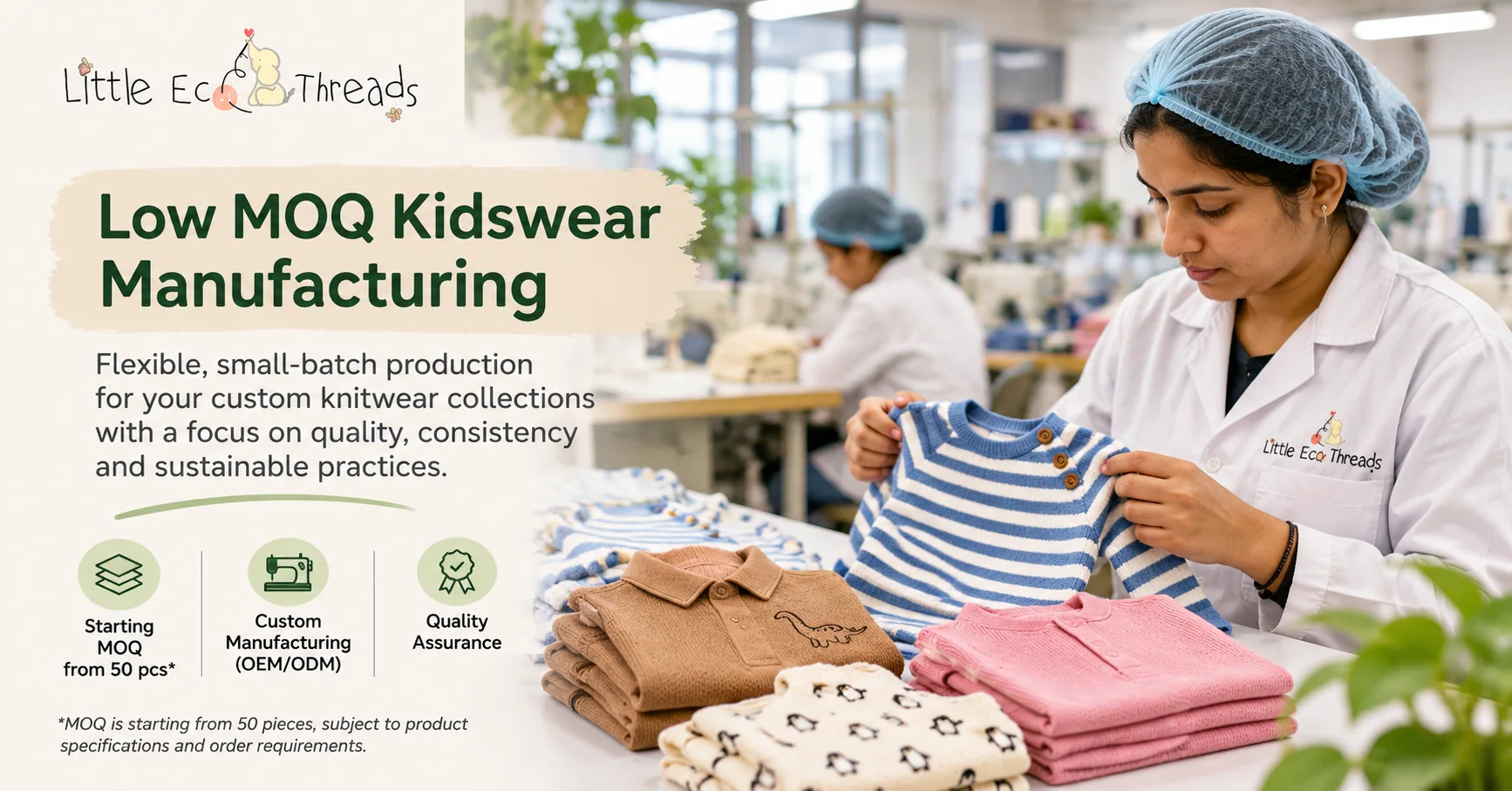
Little Eco Threads offers low MOQ production starting from 50 pieces, where this applies to the selected product and order specifications. Colour, fabric, size split and decoration all influence what is feasible, and some styles in the Knits collection are listed at 100 pieces. The most reliable approach is to share the design brief and target quantity early so the minimum can be confirmed against the actual spec.
How to Choose an Organic Cotton Kidswear Manufacturer
A factory can look right on paper and still be the wrong fit. A few checks separate a reliable clothing manufacturer supplier from one that will cause problems at bulk stage.
- Fabric and yarn quality: Ask for swatches and wash-test them. Check pilling, shrinkage and colour fastness, not just softness on the day.
- Manufacturing expertise: Look for real knitwear experience. Ribbed and waffle knits behave differently from wovens in cutting and stitching, and a factory used to them will anticipate issues.
- Customisation capability: Can it develop colours, prints and trims to your spec, or only offer catalogue options?
- Minimum order quantities: Ask whether the stated MOQ applies per style, colour or size.
- Quality control: Find out where inspections happen, such as inline and final, and how defects are reported.
- Certifications and compliance: Request the certificate, check the scope covers the product you are buying, and confirm it is current. Test requirements for your destination market should be clear too.
- Communication and transparency: Responsive, specific answers during enquiry usually predict how production will go.
- Sampling and product development: Ask how many sample rounds are typical and how long each takes.
- Export experience: Packaging, labelling, documentation and shipping to the US, EU, UK or Australia each have their own requirements.
One point deserves emphasis: certification should be checked against the specific order, not assumed from a logo on a website. A manufacturer may hold GOTS certification for some production while a given fabric or trim falls outside it. A good partner will tell you plainly which items are covered.
The broader reason to be careful is that supplier relationships compound. Once a brand has a factory that understands its fits, tolerances and colour standards, each season gets easier. Switching suppliers resets that learning, so the first selection is worth the time.
Private Label and OEM Kidswear Manufacturing: Which Model Fits Your Brand?
The terms get used loosely, so it helps to separate them. In OEM (original equipment manufacturing), the brand supplies the design, tech pack and specifications, and the factory produces to that brief. In ODM (original design manufacturing), the factory contributes the design and development, and the brand selects, adapts and sells it. Private label is the commercial result: products made by a manufacturer and sold under the brand's own name, whether the designs originated with the brand or the factory.
Most kidswear brands end up with a mix. A startup may begin with ODM styles, adjusting colours, labels and small details to build a first range quickly. As the brand matures and its design voice sharpens, more of the range moves to full OEM development from its own sketches and tech packs.
Whichever route is chosen, a private label collection usually involves:
- Specifications: measurements, grading, fabric weights and construction details
- Custom designs: exclusive colours, prints, embroidery and trims
- Labels: woven or printed neck labels, care labels and size labels, with the right compliance information for the destination market
- Packaging: polybags, hangtags, folded presentation or gift packs that match the brand's positioning
A good manufacturer helps tighten each of these before sampling, because an unclear tech pack is the most common cause of sample revisions. Little Eco Threads supports private-label, OEM and ODM production, so brands can start from a finished design in the catalogue or bring their own.
Why Consider Little Eco Threads for Sustainable Kidswear Manufacturing?
Little Eco Threads is a baby and children's clothing manufacturer based in Noida, Uttar Pradesh, and a division of Home Fashion India. It produces for brands in Europe, the US and Australia, with a focus on sustainable materials and flexible order sizes. For a brand weighing up manufacturing partners, these are the capabilities most relevant to knitwear:
- Sustainable kidswear and babywear: organic cotton, bamboo and other natural-fibre options across baby and children's categories
- Custom product development: exclusive knit colours and patterns, plus sampling with fast turnaround
- OEM, ODM and private-label production: from catalogue-based styles to fully brand-specified designs
- Low MOQ manufacturing: starting from 50 pieces, subject to product specifications
- Broad size range: from 0-3M up to size 13
- Quality control: bulk manufacturing with full QC
- International experience: regular production for export markets
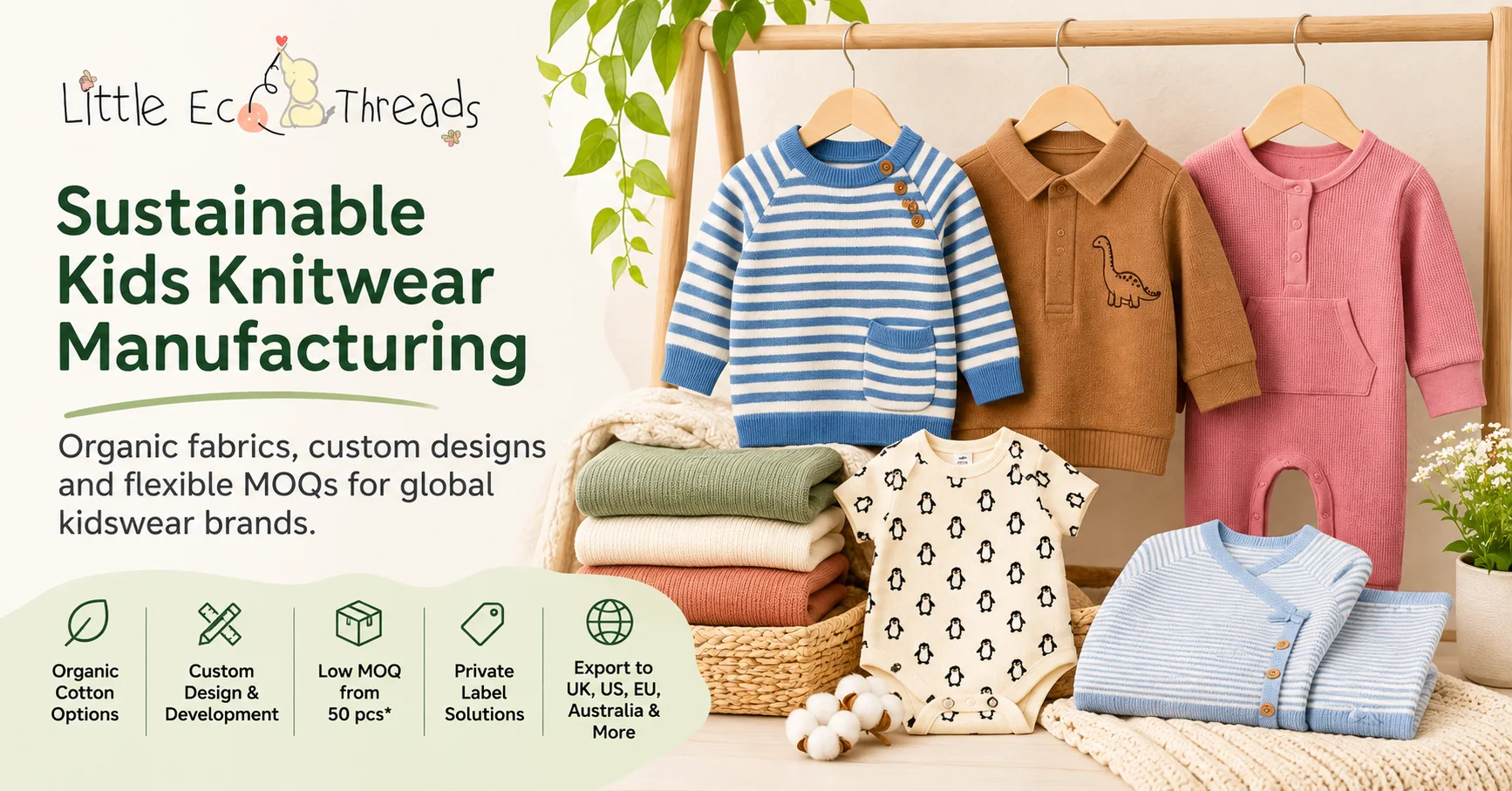
On certification, the company states that it is GOTS, SEDEX and GRS certified. As with any supplier, brands should confirm which certificates apply to the specific fabrics and styles in their order. GOTS relates to organic fibre and its processing, GRS to recycled content and SEDEX to social and ethical compliance audits, so each answers a different buyer question.
The Knits collection is the most direct way to see the range: ribbed rompers, wrap cardigan sets, sweatshirts, hooded towels, joggers and leggings, shown with MOQs per style. Brands can browse the wider product catalogue, read the sustainability page and check the FAQs before getting in touch.
Frequently Asked Questions
What is a typical MOQ for custom kids knitwear?
It varies by fabric, colour, decoration and size split. Many manufacturers ask for several hundred pieces per style, while low MOQ producers work with smaller runs. Little Eco Threads starts from 50 pieces on applicable products, with some Knits styles listed at 100.
Is organic cotton knitwear more expensive to manufacture?
Often, yes. Certified fibre and audited processing add cost, and small runs raise unit prices further. Brands usually offset this through positioning, tighter ranges and fewer markdowns.
Can a new brand develop private-label kidswear without its own design team?
Yes. ODM routes let a brand start from existing designs and customise colours, labels and details, then move towards full OEM development as its range grows.
Building Better Kidswear Collections with the Right Manufacturing Partner
Three decisions shape most kidswear collections: the material, how far the design is customised, and how much stock the brand commits to up front. Organic cotton knitwear addresses the first, provided the certification is real and covers the product. Custom colours, prints and details address the second. Flexible minimums make the third manageable, especially for new labels and for established brands testing something different.
The manufacturer you pick sits behind all three. If you are planning a knitwear range, private-label collection or wholesale order, browse the Knits collection, request fabric swatches, or contact Little Eco Threads with your design brief and target quantities to discuss what is feasible.