Textile Certification Guide for Kidswear Brands
Textile Certification can feel confusing when you are starting a sustainable fashion or kidswear brand. One supplier mentions GOTS. Another talks about Sedex. A retailer asks for CPSIA testing. A European buyer brings up REACH. Suddenly, designing a beautiful collection is only one part of the work.
For founders building a sustainable kidswear brand, the goal is not to memorize every standard. The goal is to understand what each certification, audit, or regulation actually means, what claims it supports, and what documents you should ask your manufacturer for before placing an order.
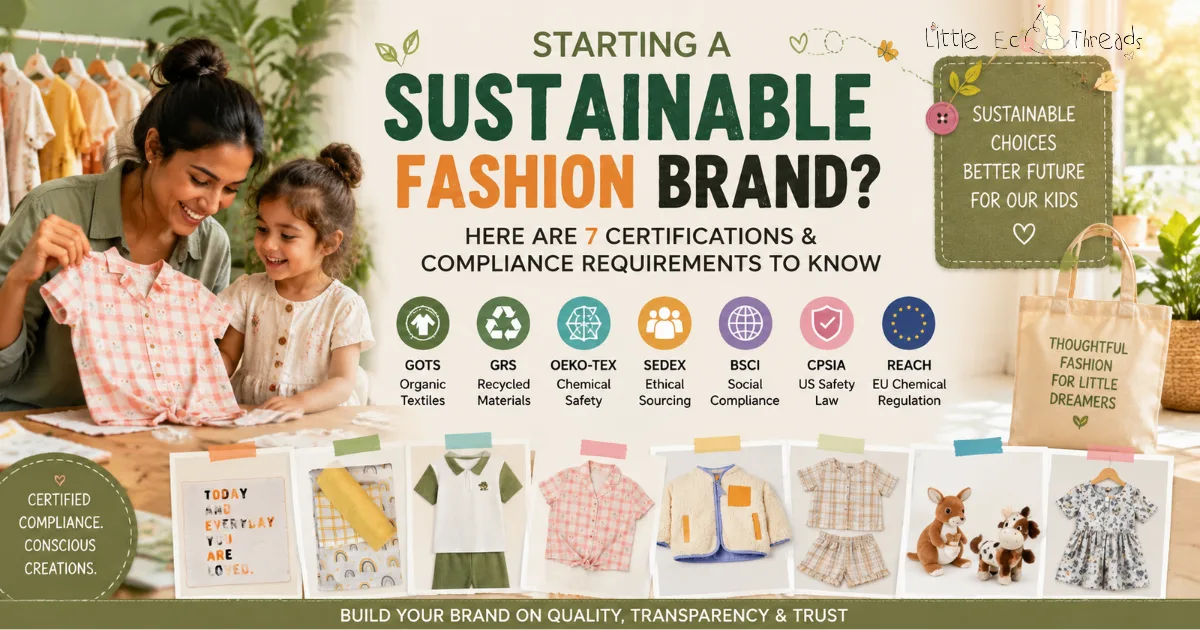
This guide explains seven important clothing certifications, audit systems, and compliance requirements that sustainable kidswear founders should know before production.
First, Not Everything Is A Textile Certification
Before looking at the list, it helps to separate four different categories.
| Term | What It Means | Examples |
|---|---|---|
| Certification | A third-party body verifies a product, material, process, or facility against defined criteria. | GOTS, GRS, OEKO-TEX Standard 100 |
| Audit or platform | A structured assessment or data-sharing system, usually focused on factory practices. | Sedex, SMETA |
| Social compliance system | A framework that assesses labor and ethical trade performance. | amfori BSCI |
| Law or regulation | A legal requirement for a target market, not a voluntary badge. | CPSIA, REACH |
This distinction matters. Calling Sedex a certification, or saying a factory is "CPSIA certified," can create inaccurate marketing language. Retailers, compliance teams, and experienced sourcing managers notice the difference.
1. GOTS: Global Organic Textile Standard
Global Organic Textile Standard is one of the most recognized standards for organic textiles. GOTS certification applies across parts of the organic textile supply chain, including processing and manufacturing, depending on the scope of certification.
For a founder, GOTS matters because it can support organic textile claims with third-party verification rather than supplier language alone.
What GOTS Helps Verify
- Organic fiber status and processing
- Environmental criteria across certified stages
- Chemical restrictions in processing
- Social criteria within the certified supply chain
- Labelling rules for certified products
If your brand wants to market GOTS certified organic cotton, ask whether the certificate covers the fabric, the facility, the processing stage, or the finished product. Scope matters.
What To Ask Your Manufacturer
- Can you share the current GOTS certificate?
- What company or facility is listed on it?
- Does it cover the exact fabric or product I am ordering?
- Can I verify the certificate with the certification body or database?
- Will transaction-level documentation be available for my order?
2. GRS: Global Recycled Standard
GRS is owned by Textile Exchange and is used for recycled material claims. It helps verify recycled content and chain of custody, and it also includes social, environmental, and chemical requirements for certified processing.
GRS is useful when a sustainable clothing brand wants to use recycled polyester, recycled cotton, recycled nylon, or other reclaimed materials.
What GRS Helps Verify
- Recycled material input
- Chain of custody through the supply chain
- Responsible processing requirements
- Chemical restrictions
- Third-party certification
GRS is voluntary, but if your product story depends on recycled content, documentation matters. A supplier saying "recycled" is not the same as being able to prove it.
What To Ask Your Manufacturer
- Can you provide a current GRS certificate?
- What recycled material percentage is used?
- Does the certificate cover the fabric supplier or the garment manufacturer?
- Can this material be traced through documentation?
- What claim can my brand safely make?
3. OEKO-TEX Standard 100
OEKO-TEX Standard 100 is a product testing and certification system for harmful substances in textiles. It is especially relevant for babywear and children's clothing because parents care about what touches a child's skin.
OEKO-TEX Standard 100 is different from GOTS. GOTS is focused on organic textile standards and certified processing. OEKO-TEX Standard 100 focuses on testing the finished textile product and its components against substance limits.
What OEKO-TEX Standard 100 Helps Verify
- Testing for harmful substances
- Product-class requirements based on use
- Coverage of components such as fabric, trims, linings, and accessories when included
- Annual certificate renewal
For kidswear, ask whether the certificate covers the full garment or only a fabric component.
What To Ask Your Manufacturer
- Which OEKO-TEX product class does the certificate cover?
- Does it apply to baby products?
- Does it cover the finished garment or only the fabric?
- Can you share the certificate number?
- When does it expire?
4. Sedex And SMETA
Sedex is a responsible sourcing platform, and SMETA is an audit methodology used to assess supplier sites. This is not the same as a textile certification.
Sedex and SMETA are commonly used to review labor standards, health and safety, environmental practices, and business ethics. They can be useful evidence for ethical sourcing, especially when a retailer wants to understand factory conditions.
What Sedex And SMETA Help Assess
- Labor standards
- Health and safety
- Environmental management
- Business ethics
- Corrective action plans after audits
Sedex should not be described as "Sedex certification." A more accurate phrase is Sedex membership or a SMETA audit.
What To Ask Your Manufacturer
- Is the factory an active Sedex member?
- Do you have a recent SMETA audit report?
- Which audit pillars were covered?
- Were corrective actions raised?
- Have corrective actions been resolved?
5. amfori BSCI
amfori BSCI is a social compliance monitoring system used by many buyers, especially in Europe. It evaluates suppliers against a code of conduct and produces audit results or ratings rather than a product certificate.
For sustainable fashion brands, amfori BSCI can be relevant when ethical labor practices are part of the sourcing requirement.
What amfori BSCI Helps Assess
- Working hours
- Compensation practices
- Occupational health and safety
- Worker protection
- Management systems
- Social compliance performance
Like Sedex, this is not a product certification. It is a way to assess factory-level social compliance.
What To Ask Your Manufacturer
- Does your factory participate in amfori BSCI monitoring?
- What was the most recent audit rating?
- Can I review the audit report or rating summary?
- If not, do you have an equivalent audit such as SMETA?
6. CPSIA For The US Market
CPSIA stands for the Consumer Product Safety Improvement Act. It is a US law enforced by the Consumer Product Safety Commission, not a voluntary clothing certification.
For children's products sold in the United States, CPSIA can involve testing, certification, tracking labels, and compliance with applicable safety rules. Requirements vary by product category, so brands should work with qualified labs, import advisors, or compliance professionals before production.
Why CPSIA Matters
- It applies to many children's products in the US.
- It is a legal requirement, not a marketing badge.
- Non-compliance can create recalls, rejected shipments, or enforcement risk.
- Responsibility often falls on the importer or brand placing the product on the US market.
What To Ask Your Manufacturer
- Have similar products been tested for US children's product requirements?
- Can you support testing through a CPSC-accepted lab?
- Can you help create tracking labels?
- Can you provide documents needed for a Children's Product Certificate?
- Are there product-specific rules for trims, drawstrings, coatings, or small parts?
7. REACH For The EU Market
REACH is a European Union regulation managed by the European Chemicals Agency. It applies to chemical substances and affects many products placed on the EU market, including textiles and clothing.
For a sustainable clothing brand selling into Europe, REACH matters because dyes, finishes, coatings, prints, and treatments may involve restricted substances.
Why REACH Matters
- It is a legal regulation, not a voluntary certification.
- It affects chemical substances used in products sold in the EU.
- It can apply to clothing, textiles, footwear, and accessories.
- Brands need supplier evidence and testing where relevant.
What To Ask Your Manufacturer
- Are the fabrics, dyes, prints, finishes, and trims suitable for the EU market?
- Can you provide REACH-related test reports where needed?
- Have you worked with brands selling into the EU?
- Which lab or testing partner do you use for restricted substance testing?
Comparing The Seven At A Glance
| Certification Or Requirement | Focus | Why It Matters | Usually Mandatory? |
|---|---|---|---|
| GOTS | Organic textile processing and certified organic claims | Supports organic textile credibility | Voluntary |
| GRS | Recycled material content and chain of custody | Supports recycled content claims | Voluntary |
| OEKO-TEX Standard 100 | Harmful-substance testing for textiles | Useful for baby and kidswear reassurance | Voluntary |
| Sedex / SMETA | Ethical trade audit and supplier practices | Helps assess labor, health, safety, environment, and ethics | Buyer-driven |
| amfori BSCI | Social compliance monitoring | Common in some European sourcing programs | Buyer-driven |
| CPSIA | US children's product safety law | Required for applicable children's products in the US | Mandatory where applicable |
| REACH | EU chemical regulation | Required for products placed on the EU market | Mandatory where applicable |
The key takeaway: certifications such as GOTS, GRS, and OEKO-TEX Standard 100 can help prove voluntary sustainability or safety claims. CPSIA and REACH are market access requirements when they apply. Sedex, SMETA, and amfori BSCI help assess factory practices rather than certifying a product.
What To Ask Your Clothing Manufacturer
Before choosing a baby and children’s clothing manufacturer, ask for more than logos on a website.
Use this checklist:
- Which certifications, audits, or compliance documents do you currently hold?
- Can you share current certificates or reports?
- What exact facility, material, or product does each document cover?
- When do the documents expire?
- Can I verify them independently?
- Do they apply to my specific order?
- What testing is needed for my target market?
- Can you support CPSIA for the US or REACH for the EU?
- What is your MOQ, and can you support small and large minimum order quantities?
- What does the sampling process look like before bulk production?
Good manufacturers answer these questions directly. Weak suppliers often rely on vague phrases such as "we are sustainable" or "we can do all certificates."
Do Not Choose Based On Certifications Alone
Clothing certifications are important, but they do not replace good manufacturing practice.
A factory with many documents can still be a poor fit if it cannot:
- Communicate clearly
- Produce consistent samples
- Meet realistic lead times
- Control quality during production
- Work at your current MOQ
- Support reorders
- Explain where materials come from
Certifications tell you that a defined standard has been checked. They do not automatically prove that the manufacturer is the right fit for your product, price point, launch timeline, or growth plan.
Where Little Eco Threads Fits
Little Eco Threads works with babywear and kidswear brands building sustainable clothing collections with certified material options, practical sampling, private label support, and flexible production planning.
For founders, the useful combination is not only documentation. It is documentation plus category experience, quality control, and order quantities that make sense for the brand's stage.
If you are developing a sustainable kidswear collection, the right manufacturing partner should help you understand which claims need GOTS, when GRS is relevant, whether OEKO-TEX testing supports your product story, and what legal requirements apply in your target market.
FAQ
What is Textile Certification?
Textile Certification is third-party verification that a textile product, material, process, or facility meets a defined standard. Examples include GOTS, GRS, and OEKO-TEX Standard 100.
Is Sedex a certification?
No. Sedex is a responsible sourcing platform, and SMETA is an audit methodology. It is more accurate to say a factory is a Sedex member or has a SMETA audit, not that it is Sedex certified.
Is CPSIA a clothing certification?
No. CPSIA is a US law for children's products. It is a legal compliance requirement where applicable, not a voluntary clothing certification.
Which certification matters most for organic kidswear?
GOTS is one of the most recognized standards for organic textiles. If a brand wants to market organic kidswear, it should ask what the GOTS certificate covers and whether documentation applies to the specific fabric or product.
Does every sustainable clothing brand need every certification?
No. A sustainable clothing brand should choose certifications based on product type, materials, claims, sales market, retailer requirements, and legal obligations.
Start With The Right Questions
You do not need to master every standard before starting a sustainable fashion brand. You do need to know the difference between a voluntary certification, a social audit, and a legal requirement.
The safest approach is simple: ask for current documents, confirm what they cover, verify them where possible, and make sure the manufacturer understands your product category and sales market.
That is how a founder moves from a good sustainable clothing idea to a product that can be sourced, tested, manufactured, and sold with more confidence.