Kidswear Manufacturer for Clothing Brands
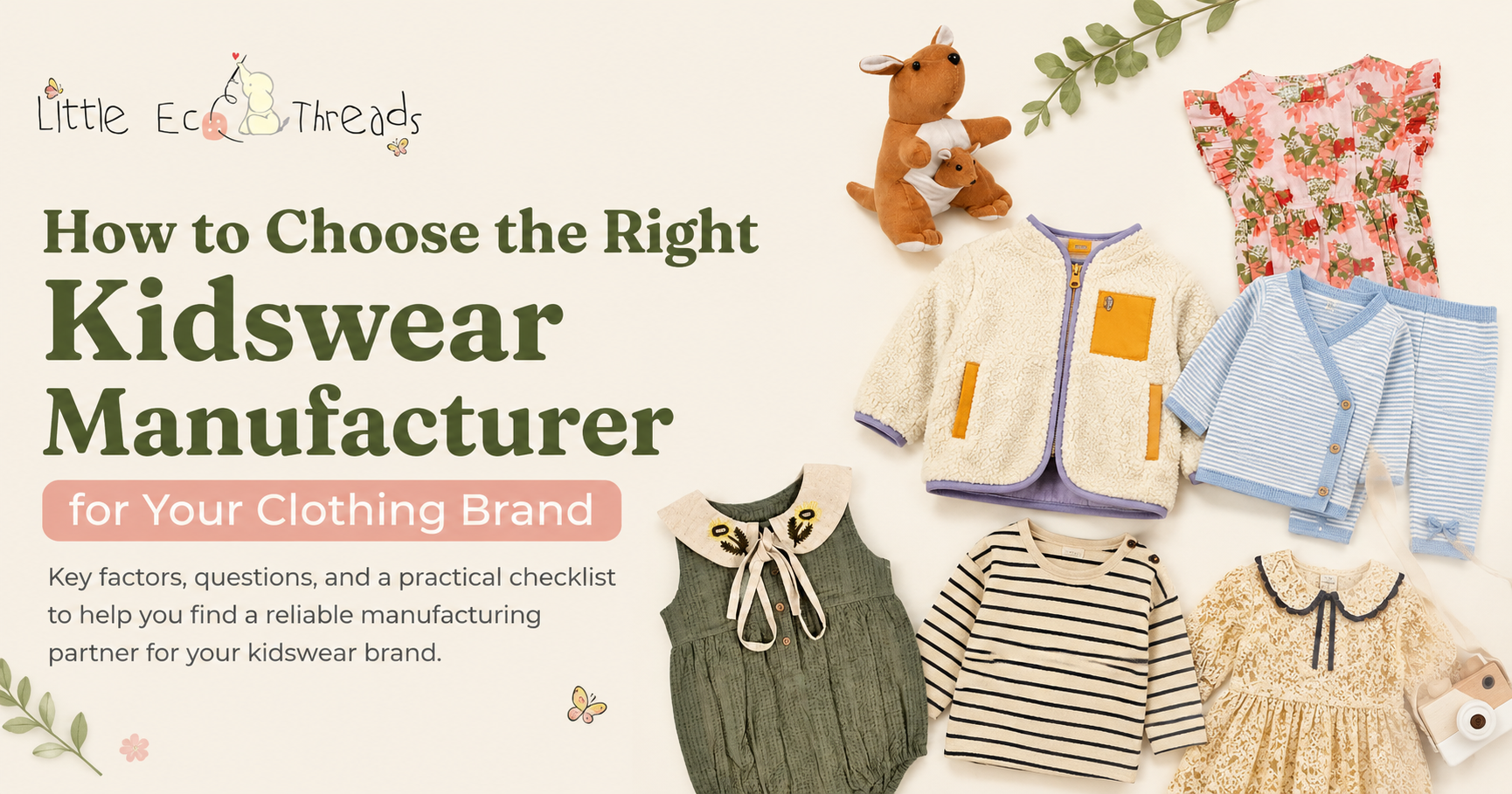
Choosing a kidswear manufacturer is one of the most important decisions a children's clothing brand will make. The right partner affects fit, fabric, durability, safety, sampling, restocks, margins, and how confidently your brand can talk about sustainability. The wrong partner can turn a promising collection into delayed samples, inconsistent sizing, avoidable defects, and inventory your customers do not want to reorder.
This guide explains what to look for in a kidswear supplier, how to compare manufacturers, and how to judge whether a factory is truly suitable for babywear, organic kidswear, custom children's clothing, or private label kidswear production.
Why The Right Kidswear Manufacturer Matters
A manufacturer is not just a production line. It becomes part of your product reputation.
Parents notice when a baby romper shrinks after two washes, when snaps feel weak, when seams rub, or when a dress loses shape before the season ends. Retailers notice when size grading is inconsistent. Founders notice when sampling takes longer than promised or when the final bulk order does not match the approved sample.
This is why choosing a kids clothing manufacturer should be based on more than the lowest unit price. Kidswear manufacturing needs a practical balance of:
- Category experience
- Fabric and trim knowledge
- Sampling discipline
- Quality control
- Certification documentation
- Realistic MOQs
- Clear communication
- Ability to scale with the brand
Getting this decision right early can save a brand from switching factories mid-growth, which is disruptive, expensive, and hard to explain to customers waiting for restocks.
Kidswear Is Not Smaller Adult Clothing
A general apparel factory can be excellent at adult T-shirts, denim, or womenswear and still be the wrong fit for children's clothing manufacturing.
Kidswear has its own product realities:
- Children move, crawl, climb, spill, and wash through clothes quickly.
- Babywear needs extra attention to trims, openings, seams, labels, and closures.
- Sizing must account for age ranges, growth, and fit tolerance.
- Fabrics need to feel comfortable against sensitive skin.
- Prints, snaps, embroidery, buttons, and coatings may carry market-specific safety expectations.
If you are selling in the United States, the Consumer Product Safety Commission clothing FAQ is a useful starting point for understanding apparel flammability and children's wearing apparel requirements. Requirements vary by market and product type, so brands should confirm rules with qualified labs, compliance advisors, or import specialists before production.
For a babywear manufacturer or children's clothing manufacturer, these details should be normal operating questions, not surprises discovered after sampling.
What To Look For In A Kidswear Manufacturer
1. Real Children's Clothing Experience
Ask how much of the manufacturer's work is dedicated to baby and kidswear, not just general apparel. A strong manufacturer should be able to show relevant product examples, explain age-specific fit issues, and discuss construction choices for garments such as rompers, dresses, swaddles, bibs, sleepwear, jackets, and baby accessories.
This matters because a factory that understands kidswear will think about comfort, durability, wash performance, closures, and finishing from the start.
2. Fabric And Material Expertise
Fabric choice affects comfort, cost, durability, sustainability, and product positioning. If your brand wants organic kidswear or organic cotton kidswear, the manufacturer should be able to discuss fabric options clearly rather than simply saying "organic is available."
Ask for:
- Fabric composition
- GSM or weight
- Knit or woven construction
- Shrinkage expectations
- Hand feel and breathability
- Colorfastness considerations
- Certification documents, if certified material is requested
For founders comparing organic cotton clothing, the useful question is not only whether the fabric is organic. It is whether the fabric is appropriate for the product, whether documentation is available, and whether the final garment will perform after repeated washing.
3. Verifiable Sustainability Standards
Terms such as "eco-friendly" and "sustainable" are easy to use and hard to verify. A credible sustainable kidswear manufacturer should be willing to explain which claims are backed by documentation.
Useful references include:
- GOTS for organic textile standards and certification systems.
- Global Recycled Standard for recycled content and related chain-of-custody claims.
- Sedex or similar social audit and supply chain due diligence platforms for worker and supplier transparency.
If a supplier mentions GOTS certified fabric, GRS certified fabric, or GOTS certified kidswear, ask what is certified: the material, the processing facility, the garment production site, or the specific transaction. A scope certificate shows what a company is certified to do; transaction-level documentation may still be needed for a specific order.
For more detail, read the Little Eco Threads guide to GOTS and GRS certification.
4. A Structured Sampling Process
Sampling is where a design becomes a real garment. Rushing this stage is one of the most common causes of bulk production problems.
A reliable sampling process should include:
- A clear brief, sketch, sample reference, or tech pack
- Fabric selection and approval
- Prototype development
- Fit review
- Construction feedback
- Revision rounds
- A final approved sample used as the bulk production reference
For custom kidswear, sampling is not optional. It is the stage where a brand confirms whether the product can be made consistently at the intended price point and quality level.
5. Quality Control During Production
Quality control should not happen only after the order is finished. By then, the cost of fixing mistakes is much higher.
Ask the manufacturer to explain checks at each stage:
- Fabric inspection before cutting
- Pattern and measurement checks
- In-line stitching checks
- Trims, labels, and closure checks
- Print, embroidery, and wash checks
- Final inspection before packing
For a deeper checklist, see the Little Eco Threads article on garment quality control.
6. Realistic Minimum Order Quantities
MOQ matters, but the lowest MOQ is not automatically the best choice. A very low minimum order quantity can raise unit cost or limit fabric choices. A very high MOQ can tie up cash in inventory before the brand has tested demand.
The better question is: what MOQ makes sense for this product, fabric, color range, and launch stage?
A startup-friendly kidswear manufacturer should be able to explain how MOQs change by fabric, style, print method, and colorway. For more detail, read the guide to choosing a low MOQ kidswear manufacturer.
7. Private Label And Custom Production Support
If your brand needs private label kidswear, ask whether the manufacturer can support:
- Custom labels
- Swing tags
- Packaging
- Size labels
- Custom prints
- Brand-specific trims
- Tech pack based development
For custom children's clothing, the manufacturer should be able to work from your design direction instead of forcing your brand into a fixed catalog. A catalog is useful for inspiration, but your production partner should understand how to adapt product construction, fabric, trims, and finishes to your brand.
8. Clear Communication And Production Transparency
Communication is often the difference between a stressful production run and a manageable one.
Look for clear answers on:
- Sampling timeline
- Bulk production timeline
- Fabric lead time
- Pricing breakdown
- Payment terms
- Revision process
- Shipping responsibility
- What happens if delays occur
If a manufacturer is vague before the order starts, communication usually becomes harder once production is under pressure.
9. Ability To Scale With The Brand
Your first order is rarely what your brand will need two years from now. A good kidswear manufacturer for clothing brands should be able to support small controlled launches and larger repeat orders as the brand grows.
Ask whether the supplier can handle:
- More sizes
- Additional colorways
- New fabric types
- Seasonal collections
- Reorders
- Larger volumes without quality dropping
This is where a specialist kidswear supplier can become a long-term partner rather than a one-off factory.
How To Compare Kidswear Manufacturers
Use the same criteria for every supplier. This keeps the decision practical and prevents one low quote from distracting from bigger risks.
| Factor | What To Check |
|---|---|
| Kidswear expertise | Experience with baby and children's clothing specifically |
| Materials | Organic cotton, GOTS certified fabric, GRS certified fabric, and suitable non-certified options |
| Certifications | Verifiable documents and clear scope |
| MOQ | Suitable minimums for your launch stage |
| Sampling | Prototype quality, revision process, and timeline |
| Quality control | Inspection steps before, during, and after production |
| Customization | Labels, packaging, trims, custom prints, and tech pack support |
| Communication | Clear answers, itemized quotes, and realistic lead times |
| Scalability | Ability to support reorders and larger ranges |
Score each manufacturer against the same table. A startup may give more weight to MOQ, sampling flexibility, and communication. An established brand may prioritize capacity, certification documentation, and repeat-order consistency.
Questions To Ask Before Choosing A Manufacturer
Use this checklist in early conversations:
- What children's clothing categories do you specialize in?
- Do you manufacture babywear as well as older kidswear?
- What fabrics do you recommend for my product?
- Can you provide organic cotton kidswear options?
- Can you provide GOTS or GRS documentation where relevant?
- What are your MOQs by style, fabric, and colorway?
- How many sampling rounds are typical?
- What is your quality control process?
- Can you work from my tech pack or design reference?
- Do you support private label kidswear?
- Can you manage custom labels, packaging, and trims?
- What are realistic sampling and bulk production timelines?
- Can you scale if my brand grows?
The strongest answers are specific. A good manufacturer will explain tradeoffs instead of promising everything.
Where Little Eco Threads Fits
Little Eco Threads works with baby and children's clothing brands that need a specialist manufacturing partner for sustainable kidswear manufacturing, custom development, and private label production.
The company focuses on children's and babywear categories, including organic cotton clothing, swaddles, rompers, dresses, sleepwear, accessories, and seasonal kidswear production. Brands can use the catalog for product direction, explore swaddles and summer kidswear, or discuss a custom range through the customized production page.
The right manufacturing fit still depends on your fabric choice, target price, MOQ, timeline, and certification needs. That is why the best next step is a specific conversation, not a generic quote.
FAQ
What is a kidswear manufacturer?
A kidswear manufacturer produces children's clothing for brands, including babywear, toddler clothing, older kidswear, private label collections, and custom designs. The best manufacturers understand child-specific fit, fabric performance, trims, safety expectations, sampling, and quality control.
How do I choose a kids clothing manufacturer?
Choose a kids clothing manufacturer by comparing experience, fabrics, certifications, MOQ, sampling process, quality control, communication, and scalability. Do not judge only by unit price.
What is the difference between a kidswear supplier and a manufacturer?
A kidswear supplier may sell existing products, source from multiple factories, or coordinate production. A manufacturer usually owns or directly manages the production process. Some partners do both, but brands should clarify who controls sampling, quality, documentation, and delivery.
Can a small brand work with a sustainable clothing manufacturer?
Yes, but the brand should be realistic about MOQ, fabric availability, certification documentation, and sampling costs. A sustainable clothing manufacturer that works with emerging brands can help plan a smaller launch without overcommitting inventory.
What certifications matter for organic kidswear?
For organic kidswear, GOTS is one of the most recognized textile standards. For recycled materials, GRS is commonly used. Brands should ask for documentation and confirm what the certification actually covers for their order.
Choose A Partner, Not Just A Price
Choosing a kidswear manufacturer is a long-term business decision. The right partner affects product quality, brand reputation, restock reliability, sustainability claims, and how confidently your collection can grow.
If your brand needs a babywear manufacturer, organic kidswear manufacturer, or custom kidswear production partner, contact Little Eco Threads to discuss your collection, fabric goals, MOQ, and timeline.