
Textile Manufacturing in India: A Sourcing Advantage
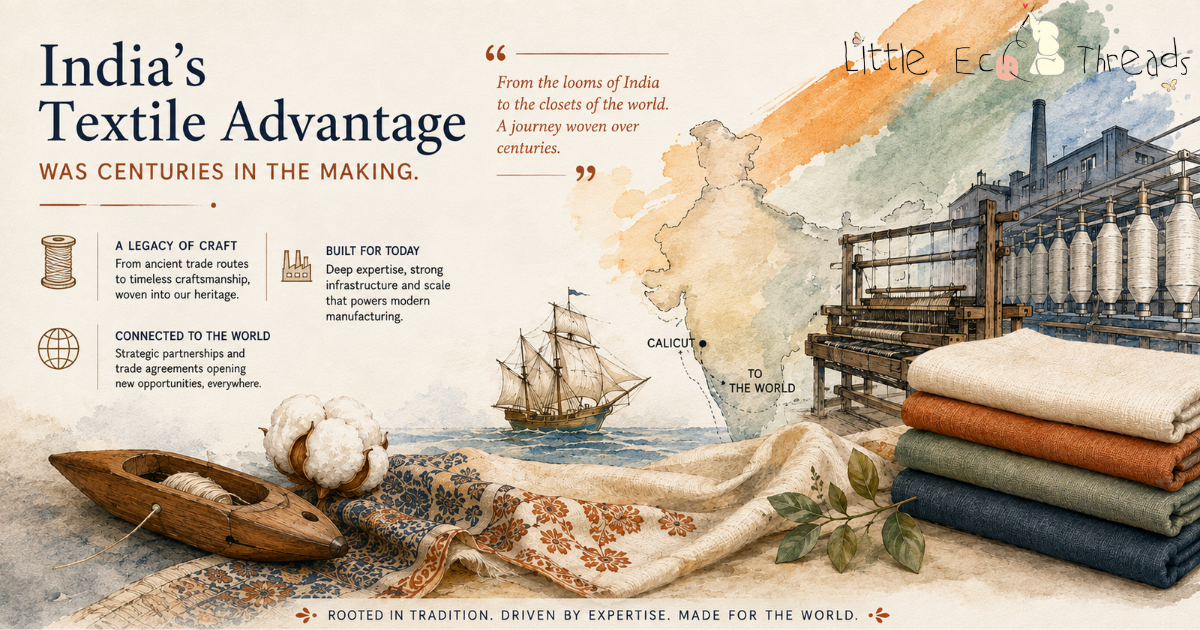
Textile manufacturing in India did not appear suddenly because global brands needed another sourcing option. It grew from centuries of cotton cultivation, weaving, dyeing, printing, port trade, regional specialization, and later industrial manufacturing. For founders and sourcing teams today, that history matters only if it translates into a practical advantage: better material access, stronger supplier networks, quality control, export experience, and more realistic paths from sketch to shipment.
This article explains why India remains one of the most important apparel sourcing countries for babywear, kidswear, and private label clothing brands, and where a manufacturing partner such as Little Eco Threads fits into that larger system.
Textile Manufacturing In India Has Deep Roots
Long before anyone used the phrase "global supply chain," cotton cloth from India was already moving across trade routes. Calicut, now Kozhikode, became closely associated with the plain cotton cloth that later gave English the word "calico," a history summarized by Britannica's entry on calico.
The same is true of chintz, the printed and painted cotton textile that became so desirable in Europe that it shaped language, interiors, and trade policy. The word is commonly traced through Hindi and Sanskrit roots connected to spotted or brightly colored cloth, and the popularity of Indian printed cottons in Europe led to import restrictions in the seventeenth and eighteenth centuries, a useful reminder that textile competition is not a new story.
The point is not nostalgia. A founder choosing a garment manufacturer in India today is not buying a museum piece. But India's long textile history created a base of fiber knowledge, dyeing skill, weaving communities, printing traditions, and regional specialization that modern apparel manufacturing later built on top of.
Why India's Textile Past Still Matters For Modern Brands
History does not guarantee quality. A country can have extraordinary craft traditions and still produce inconsistent factory output if the wrong supplier is chosen. Apparel manufacturing in India works well when the right product is matched to the right cluster, machinery, quality system, and order size.
That is the practical lesson for brands. India's advantage is not that every factory can make every garment well. It is that many parts of the textile and apparel chain exist within the same country:
- Cotton farming and fiber sourcing
- Spinning
- Knitting and weaving
- Dyeing and printing
- Embroidery, smocking, and hand-detail work
- Cutting and stitching
- Finishing and packing
- Export documentation and logistics
When those capabilities are coordinated well, brands can reduce fragmentation in the supply chain. They can also work through development issues faster because fabric, trims, sampling, production, and export support are not scattered across too many countries.
For baby and children's clothing, that matters. Fabric hand feel, shrinkage, seam strength, print durability, trims, and compliance expectations all need to be managed together, not treated as separate decisions.
India Is Not One Manufacturing Market
One common mistake is thinking of India as a single uniform manufacturing location. In practice, textile clusters in India specialize heavily.
Tiruppur in Tamil Nadu is strongly associated with knitwear and cotton jersey production. Surat in Gujarat is known for man-made and synthetic fabrics. Panipat in Haryana has deep home textile capacity. Ludhiana in Punjab is known for woollen knitwear. Noida, Delhi NCR, Jaipur, Mumbai, Bengaluru, and other hubs each have their own strengths across apparel, embroidery, woven garments, export houses, sampling, and finishing.
India Briefing's overview of India's manufacturing locations and industrial clusters is useful because it makes this point clearly: sourcing decisions are regional, not only national.
For a founder, the better question is rarely "Can India make this?" It is "Where in India is this made well, at the order size and quality level my brand needs?"
That is where a specialist kidswear manufacturer in India can be more useful than a generic sourcing agent. The job is not simply finding factories. The job is filtering factories, fabrics, trims, testing expectations, sampling rounds, and production timelines into a chain that can actually deliver the garment.
What Makes India Useful For Baby And Kidswear Brands
Babywear and kidswear are more demanding than many founders expect. A garment has to look good, feel comfortable, survive frequent washing, and be made with careful attention to trims, seams, prints, dyes, and fit.
For brands building children's collections, India offers several sourcing advantages:
| Brand Need | Why India Can Help |
|---|---|
| Cotton and natural fibers | Strong cotton textile base and broad fabric sourcing networks |
| Printed styles | Long experience with printed cottons, digital prints, block prints, and screen printing |
| Detail-heavy garments | Skilled embroidery, smocking, appliqué, and finishing clusters |
| Baby essentials | Muslin, jersey, woven cotton, quilts, swaddles, bibs, and accessories |
| Export production | Established export houses and documentation processes |
| Sustainable sourcing | Access to organic cotton, certified suppliers, and responsible manufacturing systems |
This does not mean every supplier is right for every brand. It means there is enough depth in the market for the right partner to build a supply chain around the product, instead of forcing the product into whatever one factory already happens to make.
Textile Manufacturing In India Depends On Infrastructure Too
Craft and factory skill are only part of the story. Modern textile manufacturing in India also depends on roads, ports, utilities, testing labs, wastewater treatment, industrial parks, compliance documentation, and export processes.
This is why infrastructure programs matter to apparel brands, even when the details sound technical. Invest India describes the PM MITRA scheme as part of a broader textile transformation, with integrated textile parks planned across multiple states to support spinning, weaving, dyeing, processing, and garmenting in more coordinated manufacturing ecosystems.
For a brand, the practical impact is simple: better infrastructure can reduce avoidable delays. It can make sampling more predictable, bulk timelines easier to plan, and supplier coordination less fragmented.
That matters most when the brand is small. A large retailer may be able to absorb delays or split production across multiple suppliers. A younger brand launching its first babywear or kidswear range usually cannot. One late shipment can disrupt photography, wholesale delivery, campaign timing, and cash flow.
Trade Agreements Are Changing The Sourcing Calculation
Trade agreements do not automatically make a garment cheaper, and they should not be treated as legal or customs advice. Duties depend on product category, HS code, origin rules, documentation, and the destination market.
Still, trade agreements can change the sourcing calculation. Australia already provides an official guide to using the Australia-India Economic Cooperation and Trade Agreement for companies doing business with India. EFTA has also published updates on the EFTA-India Trade and Economic Partnership Agreement. For the UK, the House of Commons Library's UK-India Free Trade Agreement briefing is a useful current reference point.
For founders, the action step is not to assume a tariff benefit. It is to ask freight forwarders, customs brokers, and sourcing partners how duties, origin rules, documentation, and landed cost apply to the exact garment being imported.
If you are planning to import apparel from India to the USA, this same discipline applies. The product's classification, documentation, compliance obligations, and testing expectations matter as much as the country of manufacture.
Sustainable Textile Manufacturing Still Requires Verification
India has strong sustainable sourcing potential, especially for brands interested in cotton, organic cotton, traditional textile processes, and certified supply chains. But sustainable textile manufacturing is never automatic.
Organic cotton grown responsibly can still move through a weak dyeing or finishing process. A supplier may claim certified materials but fail to provide documentation for the exact fabric used in production. A beautiful swatch may not perform after repeated washing if the construction, finishing, or quality checks are poor.
That is why brands should treat sustainability as a verification process, not a label. A responsible manufacturer should be able to explain:
- Which fiber is being used
- Whether the material is certified
- What the certification actually covers
- Which facility handles dyeing or printing
- How wastewater and chemical management are controlled
- What quality tests are performed before bulk production
- Which documents will be available for the brand's records
For a deeper framework, the Little Eco Threads guide to sustainable apparel manufacturing explains how material selection, processing, traceability, durability, and production planning work together.
Quality Control Is The Real Test Of Manufacturing Depth
The strongest sourcing country on paper can still fail a brand if the approved sample and bulk order do not match. Quality control is where the promise of textile manufacturing in India becomes real or falls apart.
For baby and kidswear, quality checks should look beyond basic stitching. A serious partner should check shrinkage, colorfastness, pilling, print placement, seam strength, snap or button security, size grading, and consistency across production lots.
This is especially important for lower-volume brands. When order quantities are modest, every faulty unit hurts margin more. Every delay affects launch timing more. Every unclear spec creates more friction because there is less room to absorb mistakes.
Little Eco Threads approaches this work from a children's clothing perspective: fabric selection, sampling, production planning, and quality control are connected from the beginning rather than checked only at the end.
How To Evaluate A Garment Manufacturer In India
If you are comparing suppliers, use questions that reveal operating discipline rather than only price.
Ask:
- Which product categories do you make most often?
- Which fabric constructions do you recommend for this design?
- Where will the fabric be sourced, knitted, woven, dyed, or printed?
- Can you support my target MOQ without compromising quality?
- What certifications can be documented for the material or facility?
- How many sampling rounds are realistic?
- What tests are included before bulk shipment?
- How do you keep bulk production aligned with the approved sample?
- Who manages export documentation and freight coordination?
- What happens if fabric, trims, or color approval changes during development?
Good answers are specific. Weak answers stay generic. If a manufacturer cannot explain the production path clearly before the order starts, it is unlikely to manage problems clearly once production is under pressure.
Where Little Eco Threads Fits
Little Eco Threads works with brands developing baby and kidswear collections from India, with an emphasis on sustainable fabrics, practical minimums, sampling support, and export-ready production.
For founders, the value is not simply that India has textile depth. The value is having a partner who can navigate that depth: choosing the right fabric, matching the right production process, checking quality early, managing documentation, and keeping the finished product aligned with the brand's price point and sustainability promise.
Brands can explore the Little Eco Threads catalog for product direction, review the company's sustainability approach, or start a sourcing conversation through the contact page.
FAQ
What is the main advantage of textile manufacturing in India?
The main advantage is depth. India has fiber sourcing, fabric production, printing, embroidery, garment manufacturing, export experience, and regional specialization within one country. This can help brands build more coordinated supply chains when they work with the right partner.
Is India good for baby and kidswear manufacturing?
Yes, India can be strong for babywear and kidswear, especially cotton garments, muslin products, printed collections, embroidered styles, swaddles, bibs, quilts, and private label essentials. The key is choosing a supplier with category-specific experience and clear quality control.
Is manufacturing in India automatically sustainable?
No. India has strong sustainable textile potential, but sustainability depends on the specific fiber, supplier, dyeing and finishing process, certification documents, labor practices, quality control, and production planning.
What should a small brand ask before sourcing from India?
A small brand should ask about MOQ, fabric options, sampling timelines, certification documentation, quality checks, lead times, landed cost, and who manages communication across the production process.
Start With The Right Product-Supplier Match
India's textile advantage is not only that it can manufacture at scale. It is that many layers of textile knowledge, regional skill, infrastructure, and export experience exist close enough to be coordinated well.
For brands, the practical decision is still specific: choose the right product, the right fabric, the right supplier, and the right quality system. If you are planning a babywear or kidswear collection and want help turning a design idea into an export-ready product, contact Little Eco Threads to discuss your next range.